
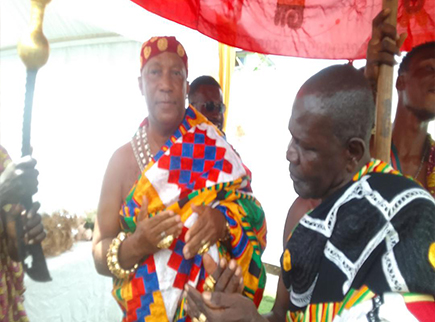
Nana Antwi Agyei Brempong II, Atwimahene, has called on the Government to implement and strictly enforce sustainable environmental policies to protect forest reserves and water bodies.
He said existing forestry laws must be rigorously enforced to curb activities contributing to climate change, particularly illegal mining, logging and unsustainable farming practices.
Nana Brempong II made the call in an interview with the Ghana News Agency (GNA) at Atwima in the Ashanti Region.
He underscored the need for communities across the country to intensify tree planting and reduce deforestation to mitigate the growing impact of climate change.
The Atwimahene explained that increasing deforestation continued to have devastating effects on the environment, including soil degradation, erratic rainfall patterns and the drying up of water bodies.
He noted that climate change was no longer a distant global concern but a present reality affecting livelihoods, especially in rural communities that depend heavily on agriculture and natural resources.
Nana Brempong II urged schools, religious institutions and civil society organisations to incorporate environmental education into their activities to instill a culture of conservation among the youth.
He also condemned indiscriminate dumping of refuse, describing it as an outdated practice that must cease in modern society.
The traditional leader appealed to the Government to provide logistical support, including seedlings and technical expertise, to enable communities to undertake large-scale tree planting exercises.
He said community-led initiatives, when properly supported, could significantly restore degraded lands and improve biodiversity.
While commending national tree planting campaigns, he stressed the need for consistent monitoring and maintenance to ensure the survival and long-term impact of planted trees.
Nana Brempong II further highlighted the importance of the River Run Indigenous Plantation (RRIP) Project, an initiative he introduced to restore degraded lands and protect water bodies in the Atwima area.
He explained that the project focuses on planting indigenous tree species along riverbanks and wetlands to restore ecosystems and prevent further environmental degradation.
According to him, the initiative, undertaken in collaboration with partners in Germany, has led to the planting of more than 8,000 trees in communities, particularly along rivers and water bodies.
He said restoring vegetation along riverbanks would help stabilise soil, prevent erosion and flooding, and support the natural regeneration of aquatic ecosystems.
Nana Brempong II called for continuous monitoring and proper maintenance of planted trees to ensure their sustainability and long-term benefits.
He urged traditional authorities, youth groups and environmental stakeholders to support and replicate such indigenous plantation initiatives across the country.
He emphasised that the success of the RRIP Project demonstrated that community-based solutions, when adequately supported, could play a critical role in addressing climate change and environmental degradation in Ghana.
Nana Brempong II called on all citizens to regard environmental protection as a shared responsibility, stressing that collective action was essential to safeguarding the country’s natural resources for future generations.