
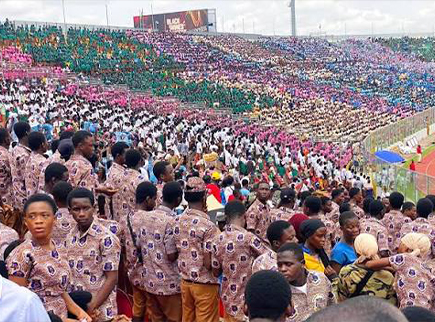
Inter-school sporting competitions serve as an opportunity to unearth, nurture and build on talents as well as promote physical body exercise and discipline in schools.
Sporting competitions like inter-schools, zonal and super zonal as well as soccer and athletics promote camaraderie, teamwork and healthiness.
However, recently those reported events in Senior High Schools had increasingly been characterized and marred by violent extremisms, raising concerns about the growing indiscipline in second cycle institutions.
Inter-school sports
In fact, reported cases of incidents of disorders undermined the core objective of inter-school sports of showcasing talents and sportsmanship.
Mr Foster Kwame Opoku Boakye, the Bono East Regional Director of the National Sports Authority (NSA) noted that the primary objective of inter-school sports was to identify and nurture talents, besides strengthening peace and social bonds.
He said it was unfortunate that those sporting activities had been characterized by general misconduct, saying that: “As competitive spirit is inherent in sports, it mustn’t be allowed to degenerate into violence”.
Scenarios
Recent incidents of hooliganism and violence manifesting in inter-school sports competitions demonstrate the seriousness of the situation.
During a Super Zonal competition in Koforidua in the Eastern Region, a student of Koforidua Senior High Technical School was reportedly stabbed by students of the rival New Juaben Senior High School (SHS), close to the venue of the competition.
Another a female student of Osino SHS was also raped in a bush as the competition progresses from stages to stages.
On February 19, 2026, a highly condemnable viral video captured some students of Swedru School of Business assaulting a student of the Obrachire Senior High and Technical School.
That was during the Agona Swedru District Inter-Zonal Schools Athletics Games held in the Central Region which received serious public condemnation, sparking national discourses on inter-school sport hooliganisms.
Statistics
Available statistics from the Ghana Police Service reveal that in 2025, a total 38 cases of student violence were recorded nationwide, with the Upper East Region registering topping those cases and three similar incidents had so far been recorded in 2026.
These reported incidents underscored the urgent need for the nation to put realistic interventions in place before the situation worsened.
Institution concerns
The Inspector General of Police through the Director-General of Criminal Investigations Department of the police administration had since ordered various regional, divisional and district police commands to sensitize students on the legal implications of deviant behaviours and acts of lawlessness.
In the education sector, Dr Clement Apaak, the Deputy Minister of Education, also announced the suspension of sporting activities in the Central Region, recommending strictest sanctions against all acts of lawlessness in the region.
Teacher unions are also calling for structural reforms with the Ghana National Association of Teachers (GNAT) and the National Association of Graduate Teachers (NAGRAT) advocating formulation and enforcement of a comprehensive code of conduct to regulate waywardness in schools.
While GNAT urges educational authorities to move beyond rhetoric to implementing concrete and realistic measures, NAGRAT pushes for greater autonomy for heads of schools in the space of student discipline.
Stakeholder concerns
Other stakeholders, including some concerned parents and guardians, are expressing similar sentiments worrying about what they described as excessive external interferences in school administration.
Mr Kwabena Ntow, a concerned parent, expressed concern about the growing weakened institutional authority and called for government intervention to reverse the trend.
He said stakeholders like the Ghana Education Service, the Ministry of Education, the National Sports Authority and law enforcement agencies ought to collaborate for the enactment and enforcement of code of conduct to govern inter-school sports competitions.
Way forward
In fact, to tackle inter-school sports hooliganism requires enhanced security and intensify school education with enhanced conflict resolution practices.
Inter-school sports competitions remain an integral component in progressive development that builds and strengthens social bonds and cohesion.
However, without decisive enforcement of rules and regulations, the growing incidents of hooliganism in schools could not be tackled.
Undoubtedly, prompt and well-coordinated actions are required to bring sanity and restore confidence as well as preserve the integrity of inter-school sports competitions in the country.