
Dr Zanetor Agyeman-Rawlings, Minister of Environment, Science and Technology, has urged journalists to intensify public education on Ghana’s impending ban on Styrofoam products and the need for safe waste collection and environmentally friendly alternatives.
Effective public communication was necessary to help consumers, food vendors, traders, and businesses understand the implications of the ban and adjust their practices ahead of its implementation.
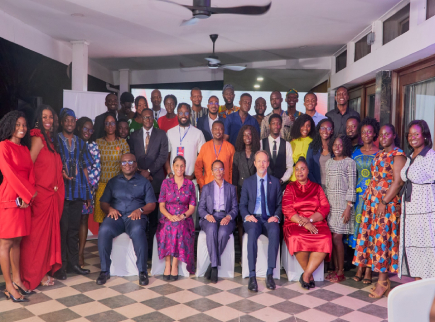
Dr Agyeman-Rawlings made the call at the closing ceremony of the 2026 UK Media Excellence for Emerging Technologies (UK MEET) Fellowship in Accra.
She said an institute under the Council for Scientific and Industrial Research (CSIR) was transforming Styrofoam waste into building tiles, demonstrating how scientific research could contribute to addressing environmental challenges.
The Minister urged journalists to investigate the innovation and engage the researchers to establish how the process worked, its potential to manage waste, and whether it could be scaled up.
She noted, however, that innovations of that kind required organised and safe collection and disposal systems to prevent Styrofoam waste from entering drains, waterways and other parts of the environment.
Ghana is preparing to prohibit the production, importation, distribution, sale and use of polystyrene foam products, commonly known as Styrofoam or takeaway packs, from January 2027.
The Environmental Protection Authority (EPA) has announced January 1, 2027, as the effective date of the ban. The policy forms part of efforts to tackle plastic pollution and the environmental problems associated with non-biodegradable packaging, including waste accumulation and blocked drains.
The EPA has urged traders, food vendors, importers and consumers to begin moving towards alternatives ahead of enforcement.
Dr Agyeman-Rawlings said public education should go beyond announcing the ban to explain why it was being introduced, how people could comply and what alternatives were available.
Professor Eric Opoku Mensah, Vice-Chancellor of the University of Media, Arts and Communication (UniMAC), said journalists reporting on science and environmental issues should examine the evidence behind claims and explain their implications in language audiences could understand.
He urged reporters to investigate whether proposed solutions worked in practice and to follow up on whether policies and promised interventions delivered the intended results.
Professor Opoku Mensah said journalists should also incorporate community experiences into their reporting, noting that the experiences of people affected by environmental problems could complement scientific explanations.
He encouraged the media to use local languages where appropriate and to ensure that scientific and technological information was accessible beyond academic and professional audiences.
The Vice-Chancellor said sustained reporting was important because public interest in an issue should not disappear after the initial announcement, particularly when the success of an environmental policy depended on changes in public behaviour.
The UK MEET Fellowship, delivered by Imperial College London through Imperial Global Ghana in partnership with the British High Commission in Accra and the UK in Nigeria, with support from the UK Foreign, Commonwealth and Development Office, brought together 30 Ghanaian journalists and content creators for training in science and technology reporting.
The programme covered artificial intelligence, climate change and resilience, biomedical innovation and public health, and electronic waste and the circular economy, equipping participants to scrutinise claims, assess evidence and communicate complex issues accurately.