
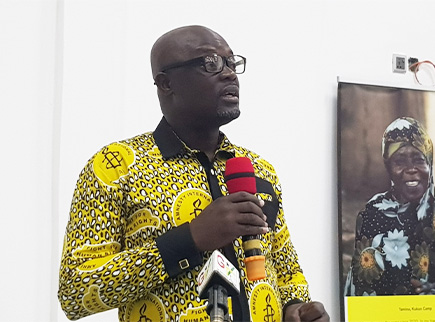
About 60 percent of the nation’s major rivers are highly polluted with heavy metals, with turbidity running into thousands, Mr. Erastus Asare Donkor, an investigative journalist and environmentalist has said.
He attributed the cause of the pollution to the growing illegal mining activities in the country, saying, the menace had also denied many farmers accessing arable farmlands too.
Describing illegal mining as serious environmental crime and human rights violation, Mr. Donkor said: “activities of illegal miners are not only ravaging Ghana’s forest and water bodies, but also depriving communities of accessing clean water, arable lands and healthy living conditions.”
He was speaking at the opening session of the Annual General Meeting (AGM) of the AI Ghana, underway at Fiapre, near Sunyani on the theme “Resilience in a Restricted Civic Space”.

Mrs. Easily Nemitz, the Board Chair and Dr Julia Duchrow, the Secretary General of AI, Germany, as well as representatives AI chapters in Nigeria, Burkina Faso and Cote D’Ivoire are also attending the four-day AGM.
Mr. Donkor said rivers in Ashanti, Western and Eastern Regions were the worst affected with communities “suffering in silence”, adding that, “rivers used for fishing, drinking and farming are now poisoned by mercury and cyanide.”
He said: “Crops are failing, and entire livelihoods are disappearing. When residents raise their voices, they are often met with silence or, worse, force.”
Mr. Donkor shared a heart touching story of an elderly woman in Amansie enclave of the Ashanti region, alleging that, “an illegal miner invaded her farm a few weeks ago and asked her to sell off the land, but she refused.
“However, the miner will still moving his excavator to the farm and started his gold exploration with impunity.
“When the woman and her two friends moved in to protest the action, they got arrested by the local police who would not bother to even enquire if the miner had the license to mine. But for my intervention, these vulnerable women would have suffered an unending nightmare for demand a right.”
Mr. Donkor said he was very worried, alleging that “in some instances, state forces deployed to halt illegal mining have themselves been implicated in extortion and brutality”, stating that “the lack of accountability mechanisms within the environmental governance structures creates double injustice.”
He emphasised that law enforcement remained the surest remedy to tackling illegal mining in the country. However, the “gap between legislation and enforcement has widened creating a justice vacuum where marginalized voices are drowned by power dynamics”.
Mr. Francis Nyantakyi, the Board Chairman of the AI Ghana also expressed concern about the illegal mining activities, saying “illegal mining remains an urgent human rights issue and not just an environmental one”.
Mr. Nyantakyi stressed that: “Toxic rivers, poisoned food chams, destroyed farmlands, and collapsing health systems in affected communities expose a failure of leadership and enforcement”.