
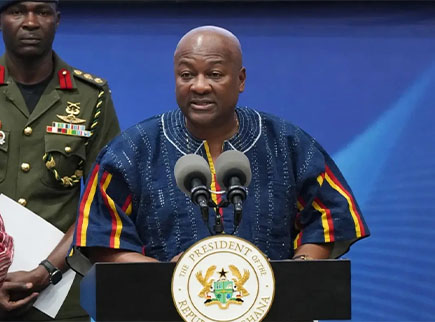
President John Dramani Mahama has inaugurated a new Vaccine Research and Development (R&D) Laboratories and a Human Identification (DNA) Laboratory at the Noguchi Memorial Institute for Medical Research, University of Ghana, Legon, Accra.
This new facility was established in response to the August 6, 2025, military helicopter tragedy, which led to the samples of the remains of the eight eminent Ghanaians, who died in the crash being sent to South Africa for DNA identification.
The Vaccine R&D Laboratories includes dedicated vaccine development facilities, featuring an mRNA Expression Laboratory and a Protein Expression Laboratory.
Whereas the Human Identification (DNA) Laboratory provides domestic infrastructure for human DNA testing and identification.
President Mahama in his address said the laboratory would help them provide families with answers in times of tragedy, and the vaccine research laboratories would also give the nation’s scientists the means to develop their own vaccines here in Ghana.
“I take immense pride in the progress we have made as a nation, and in the bold steps we continue to take to secure a healthier, stronger, more self-reliant future for generations of Ghanaians to come,” the President said.
He noted that by commissioning these facilities, they affirm their collective determination to build a Ghana that could safeguard its health security, advance scientific innovation, and chart its own course towards prosperity.
He said following the tragic events of August 6, the Government recognised the urgent need for a National Human Identification Laboratory or a DNA lab.
“That painful episode made clear how much we need scientific expertise and technology to respond effectively to national emergencies and to provide affected families with timely answers,” the President said.
He noted that such a facility was essential to protecting public health and safety and to strengthening their ability to respond to emergencies.
“As you are aware, we had to take the tissues that were recovered from the accident sites to South Africa for analysis, and the families of the deceased had to wait for several nerve-wracking days for the results of the DNA to return,” he said.
“It was a day of shame for Ghana that we couldn’t carry out our own DNA analysis in-country. That will be a thing of the past,” he said.
President Mahama said, he was now proud that Ghana had a world-class facility that would strengthen forensic as well as public health systems and enable experts to handle delicate cases with competence, dignity, and independence.
He noted that behind every request for identification was a family that was anxiously waiting for news, and this wait could deepen the pain of loss and delay the chance to lay a loved one to rest.
“We must therefore apply the same care to communicating with families as to scientific work itself,” he said.
He encouraged the agencies that would rely on the laboratory, to work closely so that families received clear information in a timely manner.
He stated that the DNA Laboratory would also assist in several other forensic investigations.
President Mahama also spoke about the establishment of facilities dedicated to vaccine research and development, acknowledging that they were was equally significant milestones that demonstrated the government’s resolve to draw on Ghanaian talent, scientific expertise, and local capacity to address the nation’s health challenges.
He recounted the critical lessons from the COVID-19 pandemic, where global demand for vaccines and other medical countermeasures rose, exposing weaknesses in the international supply chains and leaving several countries African countries dependent on external support during a crisis.
He noted that beyond COVID-19, the West Africa sub-region and the wider African continent continued to face recurring threats from infectious diseases, including M-pox, Laser fever, Ebola and the Marburg virus diseases.
Experts had repeatedly reminded countries globally of the emergence of new infectious diseases and the return of familiar ones; therefore, it was important to ensure effective preparedness, which required foresight, investment, and the courage to build capacity before a crisis strikes.
President Mahama said the government was consistently working to realise the economic potential of the pharmaceutical industry and position Ghana as a pharmaceutical hub for West Africa and the wider African continent.
He said in view of this, the Government had backed its commitment with a $1 billion allocation to pharmaceuticals under the New Economy’s Seventh Pillar, with the aim to build the Ghana pharmaceutical and biomanufacturing hubs in the Eastern, Central, and Volta Regions.
Mr Kwabena Mintah Akandoh, the Minister of Health, said the new vaccine research laboratories would give Ghanaian scientists the tools to locally develop vaccine candidates.
He said with the National Vaccine Institute, the Food and Drugs Authority and their research partners, Ghana could move from discovery to clinical trials and ultimately to vaccines made in Ghana.
https://shorturl.fm/Z9WwP
https://shorturl.fm/Wx3jq