
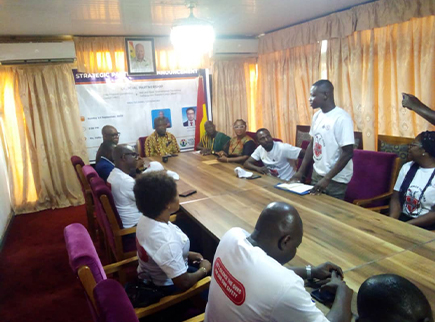
Mr James Gunu, the Volta Regional Minister, has called for an extension of the ongoing nationwide Gun Amnesty Programme to the end of January 2026 to enable more citizens to become aware of and take advantage of the initiative.
He made the call during a courtesy visit by the Gun Amnesty Programme Train to the Volta Region, led by Dr Adam Bonaa, Executive Secretary of the National Commission on Small Arms and Light Weapons.
Mr Gunu said extending the programme would deepen public education and stakeholder engagement in line with the government’s broader “resetting agenda,” stressing that unregulated gun ownership posed a serious threat to peace, security, and development.
“We cannot allow people to own guns indiscriminately and create insecurity and instability in our country and the Volta Region,” he said.
The Regional Minister noted that since assuming office, he had pursued a three-point agenda, one of which focused on ensuring peace and security to position the Volta Region as an attractive investment destination.
“Without peace and security, there can be no meaningful development,” he added.
Mr Gunu said the amnesty programme would help strengthen the region’s development agenda by promoting a peaceful environment, citing recent incidents in which firearms were discharged at public places, including religious and traditional events.
He said such incidents indicated that illegal firearms were still in circulation and called for stronger engagement with the Regional House of Chiefs and traditional authorities to regulate the use of firearms during cultural activities.
“In some communities, gunshots are considered part of traditional celebrations, and without them people feel the event is incomplete. We must work together to regulate this practice properly, otherwise the gains we make today could be lost tomorrow,” he cautioned.
Mr Gunu assured the delegation of the full support of the Volta Regional Coordinating Council and reiterated that security was a shared responsibility between government and citizens.
He also raised concerns about local firearm craftsmanship in parts of the Volta Region, calling for a national dialogue on how such expertise could be regulated and harnessed to support the economy without posing security risks.
“If firearms can be manufactured locally for legitimate security purposes, it must be done properly and regulated to turn it into an advantage rather than a threat,” he said, adding that the region remained peaceful, stable, and safe for investment.
Responding, Dr Adam Bonaa said the Commission was working to regularise local gunsmithing as part of broader legal and policy reforms on firearms control.
He described an outright ban on local weapon manufacture as problematic, noting that indigenous firearm production predated the modern state and that local artisans sometimes supported security agencies with weapon repairs.
Dr Bonaa said the Minister of the Interior had indicated that such issues were likely to be considered as part of upcoming legal reforms on firearms regulation and control.
“What we are doing now is to encourage people with illicit weapons to surrender them. If they do not, the law will catch up with them,” he said.
Dr Bonaa noted that calls for an extension of the amnesty had been acknowledged and would be conveyed to the Minister of the Interior, adding that response to the programme so far had been encouraging, with a significant number of weapons already surrendered.
He condemned recent gun-related disturbances in the region, describing them as “uncalled for,” and urged communities to resolve disputes peacefully without resorting to firearms.
“Let us settle disputes without weapons. That is how we have always lived,” he said, commending the Volta Region for its generally peaceful nature.
The nationwide Gun Amnesty Programme, declared by the Minister of the Interior, Mr Muntaka Mohammed-Mubarak, commenced on December 1, 2025, and is scheduled to end on January 15, 2026.
The initiative allows individuals to surrender illegal, unregistered, or unwanted firearms without fear of prosecution, with the aim of reducing gun violence, removing dangerous weapons from communities, and improving public safety.