
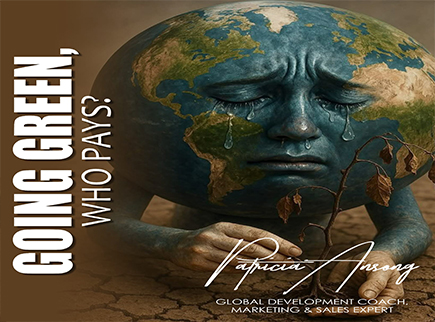
Given the prevailing measurement, financing, and accounting systems, it is safe to say that the transition is unfair to low-income households and developing nations.
This begs for a rethink, strategizing, and redirection of the entire clarion call of the green revolution, which is accompanied by all the hallmarks of a smooth-sounding, do-good intention to fix a broken world, such as: just get an electric car, install solar panels, and reduce your ecological footprint.
But what lies beneath these calming catchphrases?
The reality is a tangled web: assessments of consequence are anything but objective, and the math behind a green revolution is skewed.
Oil-rich nations and giant corporations score all the greeny browny points in terms of manufacturing, while those with the least to gain in terms of outlay are forced to shell out in the end – that is to say, the world’s least affluent households and nations.
It is a comforting idea. Almost elegant.
But the moment we try to measure green consumption; things start to get messy. Who decides what actually counts as “green”? Who pays for it? And why does your neighbor still insist electric cars are secretly powered by coal plants?
Before anything is labeled “green,” someone has already decided what is worth measuring and, by extension, what gets valued, rewarded, or ignored.
This is the logic behind green and environmental accounting, an attempt to track emissions reduced, energy saved, and resources preserved much like financial transactions.
Institutions such as the World Bank and the OECD have long noted the methodology of tracking and reporting climate finance flows and discusses the role of accounting methods in understanding those flows.
These accounting choices directly influence where climate finance flows and which countries or sectors receive recognition for impact.
These questions matter because measurement is not neutral. It shapes policy, investment, and who ultimately benefits or loses from the green transition.
Research on carbon markets and climate finance consistently shows that what is measured tends to attract capital, while what is harder to measure is often overlooked.
At first glance, governments appear to be firmly in control.
They set climate goals, introduce regulations, and announce incentives.
The European Union’s Green Deal, for example, aims to mobilize over one trillion euros in public and private investment toward climate action.
In the United States, tax credits and subsidies for electric vehicles and clean energy under recent federal legislation are reshaping consumer behavior and investment decisions.
China, meanwhile, has become the backbone of the global renewable supply chain, producing more than 70 percent of the world’s solar panels, according to the International Energy Agency.
But governments are only part of the story.
Producers quietly play referees. They decide how “green” their products really are, whether that eco-friendly T-shirt was made from organic cotton or simply marketed that way.
Investigations by the European Commission have found that a significant share of environmental claims made by companies are vague, exaggerated, or misleading, highlighting how widespread greenwashing has become in consumer markets.
Consumers are left navigating the maze. Do you buy local carrots or imported organic quinoa?
Drive a hybrid or stick to public transport? The responsibility to save the planet is increasingly placed on individuals armed with limited information, tight budgets, and moral pressure.
From my decades of marketing experience, consumers express strong environmental concern especially the gen z and the gen alpha but, price sensitivity, affordability, and convenience increasingly dominate purchasing decisions, especially during periods of high inflation.
In fact, Studies by McKinsey and UNEP show that while consumers express strong concern for the environment, affordability and convenience remain the dominant drivers of purchasing decisions, especially during periods of high inflation.
The uncomfortable part: who actually pays?
Households with lower incomes are often priced out of green choices.
According to the International Energy Agency, electric vehicles still cost roughly 20 to 30 percent more upfront than comparable conventional vehicles in many markets.
A solar-powered fridge or clean cookstove may offer long-term savings, but the initial price tag often pushes households toward cheaper secondhand alternatives.
Sustainability, in practice, carries a premium many cannot afford.
Countries without strong green industries pay differently. They import solar panels, batteries, and clean technologies, while much of the economic value and emissions accounting remains with producing countries. UNCTAD data shows that most African countries import over 80 percent of their renewable energy equipment, meaning manufacturing jobs, profits, and emissions credits are largely recorded elsewhere. If Ghana imports its solar panels, current accounting systems often allow exporting countries to claim the bulk of the production-related climate credit.
Consumers also pay emotionally
Fear of the unknown plays a role. Surveys by the Pew Research Center show that concerns about battery safety, range anxiety, and reliability remain among the top barriers to electric vehicle adoption, even in countries with expanding charging infrastructure. Mistrust and misinformation shape green choices as much as policy does.
As soon as we try to benchmark green consumption, the cracks widen further.
Some countries measure progress through renewable energy use, electric vehicle adoption, or sustainable agriculture. But a wealthy Scandinavian country is not playing the same game as a landlocked African one where, according to World Bank data, more than 40 percent of households still lack access to electricity.
At the continental level, the European Union has developed harmonized reporting systems for emissions and energy use. Africa, by contrast, continues to face significant data gaps in emissions tracking, energy consumption, and climate finance flows, as highlighted by the African Development Bank. North America shares borders, but not energy realities. Globally, while the United Nations provides a shared framework through the Sustainable Development Goals, the quality and consistency of national reporting vary widely.
In other words, the benchmark depends on where you sit and who is holding the calculator
This confusion feeds into what can only be called the production paradox. Imagine solar panels manufactured in China, shipped to Kenya, and installed on schools. Who gets the sustainability brownie points? China, for producing them? Kenya, for adopting them? Or the global community, for reducing emissions overall?
Current carbon accounting frameworks largely assign responsibility and credit at the point of production rather than consumption. The OECD and IPCC have both noted that this approach tends to favor manufacturing economies, while countries deploying green technologies absorb costs and implementation risks. It is the green economy’s version of a group project.
Across the continent’s 54 countries, governments are rolling out renewable targets, issuing green bonds, launching carbon markets, and pledging climate action. Yet despite holding nearly 60 percent of the world’s best solar resources, Africa attracts less than 5 percent of global renewable energy investment, according to the International Energy Agency.
Green projects require financing, and African countries often borrow at interest rates two to three times higher than those of advanced economies, even for climate-related investments, as noted by the IMF. The result is that taxpayers and future generations pay more for green loans, adding strain to already stretched public budgets.
Carbon taxes and climate regulations, while necessary, can quietly raise electricity bills, transport costs, and food prices. The World Bank analyses of early carbon pricing schemes show that without targeted subsidies, lower-income households bear a disproportionate share of transition costs. Clean technologies like solar farms, wind projects, and carbon markets bring opportunities, but also trade-offs. FAO research shows that communities engaged in forest conservation for carbon credits often face restrictions on land use and changes to traditional livelihoods, shouldering local costs for global climate benefits.
Trade adds another burden. Meeting global green standards and carbon border measures is costly, and failure can shut African exporters out of key markets, particularly in Europe, as documented by UNCTAD. Even initiatives designed to promote inclusion, such as rural electrification programs, frequently require upfront payments that many households cannot afford without subsidies or innovative financing models.
Which brings us to the way forward
If green consumption is meant more than a slogan, we need smarter measurement tools that move beyond simple checklists and capture lifetime carbon impact. We need fair accounting systems that recognize both producers and users in the green economy. Accessibility must be central, because if green remains expensive, it will stay elite. And transparency matters. Consumers deserve clear, honest labels, not marketing slogans disguised as sustainability.
In the end, measuring green consumption is like weighing yourself on three different scales. Each gives a different number, and none tells you how much cake you just ate.
Whether rich or poor, North or South, early adopter or EV skeptic, we are all part of the equation. The real challenge is making sure math works for everyone, not just the countries or companies that can afford the greenest toys.