
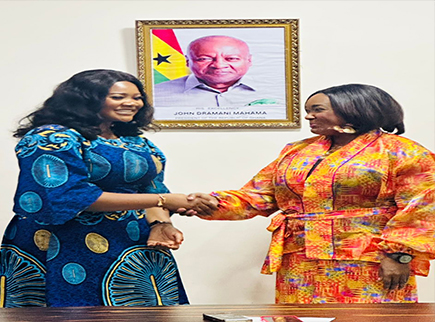
In a landmark move to bridge the creative economies of Francophone and Anglophone Africa, the Republic of Congo has initiated a creative collaboration with Ghana.
The partnership is aimed at promoting Pan-African integration through film, culture, and shared storytelling.
Madam Claudia Yoka, a renowned filmmaker and Presidential Technical Advisor from the Republic of Congo
Her delegation also included Ms. Monie Lek, a Congolese actress and Mr. Dymo Sow, a Francophone filmmaker.
The visit was facilitated and supported by the African Chamber of Content Producers (ACCP), which has been at the forefront of continental creative integration through initiatives such as the Africa Monologue Challenge and the Africa Image Ambassador Programme.
During her stay, Madam Yoka held high-level meetings with the Chief Executive Officer of the National Film Authority of Ghana, Madam Kafui Danku, as well as other key creative industry stakeholders, including veteran filmmaker Mr. Roger Quartey and award-winning filmmaker Madam Juliet Asante.
The conversations centred on how to integrate the creative economies of Francophone and Anglophone Africa to tell united African stories that resonate across linguistic and colonial boundaries.
Madam Claudia Yoka revealing why the Republic of Congo turned its attention to Ghana, cited Ghana’s historic role in the development of Nigeria’s film industry as a key factor.
Ghanaian creatives, technicians, and institutions were instrumental in the early growth of Nollywood, and Congo now seeks to replicate that transformative impact.
“Ghana has proven that it knows how to build film industries. We have seen what Ghana did with Nigeria. Now we want Ghana to do the same with the Republic of Congo,” Madam Yoka said.
She expressed the readiness of the people of the Republic of Congo to work closely with Ghanaian counterparts, noting that her government was fully supportive of the initiative.
Madam Kafui Danku, CEO of the National Film Authority, expressed the readiness of the NFA and the Government of Ghana to facilitate any policy framework needed to ensure the success of the collaboration.
She noted that Ghana was committed to becoming a hub for continental creative partnerships and that the government would remove bureaucratic hurdles to enable seamless co-productions between Ghana and the Republic of Congo.
“Visiting Congo, I was struck by the cultural difference of driving on both sides of the road yet noticed many shared aspects between our cultures. I look forward to working together and I’m committed, along with the NFA, to supporting this partnership’s success.”
Mr. Roger Quartey, veteran filmmaker and Chairman of the Media and Culture Sector of the African Chamber of Content Producers, expressed the Chamber’s full commitment to activating all networks and resources to ensure the success of the collaboration.
He recounted his personal experience as part of the team that was at the forefront of the Ghana-Nigeria collaborations that helped build Nollywood into what it is today.
“We birthed some of the best talents and most memorable projects through those collaborations,” Mr. Quartey said.
He also recalled how Ghanaian creatives collaborated with Liberia to help build a film sector there after the civil war.
“We have the experience. We have the expertise. And we are ready to initiate training and workshop sessions for creatives in the Republic of Congo.”
Madam Juliet Asante, who met the Congolese delegation, expressed her enthusiasm for the collaboration and pledged to be available whenever needed to ensure the success of the partnership.
She noted that the creative industries of both countries had much to learn from each other, and that women in particular would benefit from cross-border mentorship and production opportunities.
Madam Claudia Yoka, who also runs a film festival in her region, expressed a desire to connect Madam Juliet Asante’s Black Star International Film Festival with her festival.
The two filmmakers discovered many shared experiences and challenges, and agreed that linking their festivals would grow audiences, share resources, and elevate the profile of African cinema on both sides of the continent.
Mawuko Kuadzi, the back-to-back Artios Award winner and the highest-ranked Africa Image Ambassador (Sectoral Content Fellow) within the ACCP’s pilot programme, has been tapped to handle casting for a proposed Congo-Ghana film project, which is expected to be produced in the coming months to kick-start the collaboration.
Ambassador Kuadzi, who made history as the first African to win the casting profession’s highest honour in its 40-year history, expressed his readiness to work across both Ghana and the Republic of Congo.
“I am committed to using initiatives like the Africa Monologue Challenge to unite African creatives into a single voice to tell African stories the African way,” Kuadzi said.
He noted that the AMC had already demonstrated its ability to discover talent across the continent, and that the same model could be applied to identify and train casting professionals in Congo.
Mr. David Adofo, Head of Research and Development at the African Chamber of Content Producers, recounted how his stay in China showed him that the country’s rapid development was built on unity and shared culture.
He expressed optimism that if Africa could unite its creative economy and cultural industries, the continent could become the next frontier of global development.
“China’s rise was not an accident. It was driven by a collective identity and a shared purpose. Africa has even greater diversity and creative wealth. When we learn to tell our stories together, the world will listen,” Adofo said.
Nana Dwomoh-Doyen Benjamin, President of the African Chamber of Content Producers, threw down a challenge to African leaders to recognize the creative economy as a powerful tool for unity and development.
He encouraged leaders to have deeper conversations with passionate and experienced creatives to understand how their work could develop countries and the continent as a whole.
“Hollywood works creatively with the United States government to project and market America. That is a model African leaders must learn from,” Nana Dwomoh-Doyen stated.
“We have talents like Mawuko Kuadzi who have demonstrated that African professionals are capable of competing globally and even winning. It is time for Africa to benefit from people like him, to use them to unite and develop our continent.”
He added that the ACCP was ready to facilitate similar collaborations between other African nations, using the Congo-Ghana partnership as a blueprint for creative integration across the continent.
The delegation also visited potential filming locations in Ghana as part of preparations for a planned Congo-Ghana film project, which is expected to begin production within the next few months.
The project will serve as a flagship initiative to demonstrate the power of cross-border creative collaboration and to inspire similar partnerships across Africa.