
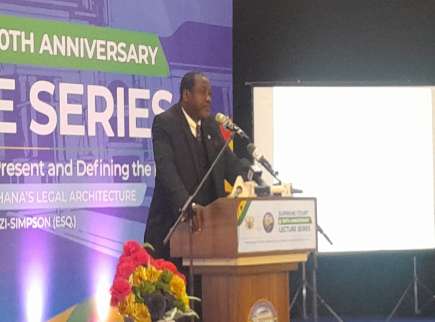
Professor Philip Ebow Bondzi-Simpson, a legal luminary and former Rector of the Ghana Institute of Management and Public Administration (GIMPA), has called for the conversion of Ghana’s Judicial Council into an independent Judicial Commission to enhance transparency, accountability and fairness within the Judiciary.
The proposed commission, he suggested, should be responsible for all matters relating to the recruitment, promotion, progression and discipline of judges to protect such processes from political influence and mitigate the perceptions of favouritism.
Reflecting on his observations of the current system over the years, he warned that a judiciary populated by disgruntled judges who believed they had been unfairly denied promotion posed a grave risk to the administration of justice.
He maintained that uncertainty surrounding promotion decisions could create dissatisfaction among judges who felt overlooked despite their qualifications and years of service, urging policymakers and stakeholders to consider the proposed reform.
“… if you have peeved, unhappy magistrates and Circuit Court judges, and High Court judges and Court of Appeal judges who think they should have been promoted and don’t know why they have not been promoted, but know that others have, they will be there, they will be paid, they will do the work but it does not serve the interest of justice,” he cautioned.
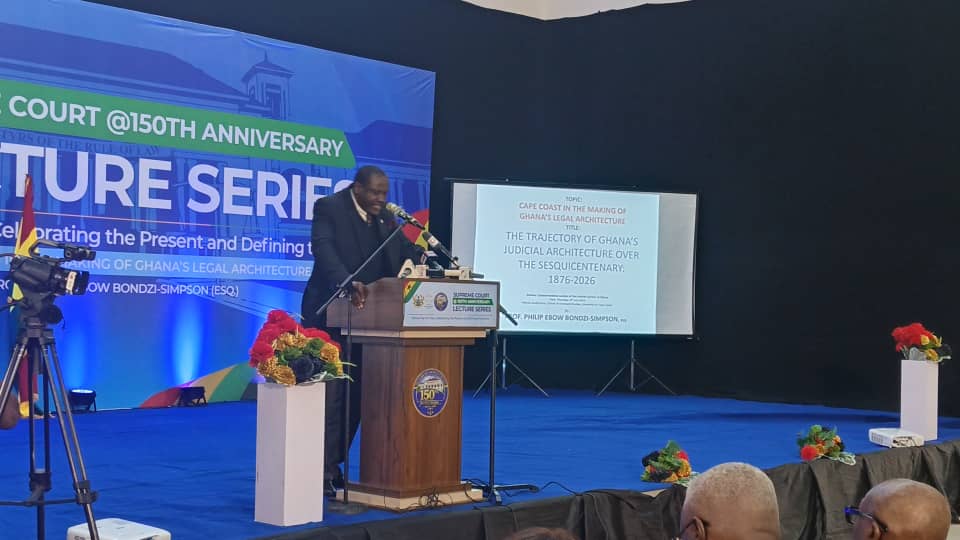
Prof Bondzi-Simpson made the recommendation when he delivered the first of three lectures commemorating the ‘Supreme Court @ 150’ anniversary at the University of Cape Coast (UCC).
Delivered on the topic: “Cape Coast in the making of Ghana’s legal architecture,” the lecture gave a detailed account of Ghana’s judicial progression, setting the records straight on the country’s judicial evolution.
The lecture also highlighted the immense role Cape Coast played in the journey, including hosting the Ghana’s first Supreme Court.
It was attended by judges, lawyers, scholars, students, traditional authorities among other stakeholders.
The colourful event also featured mock court session staged by the Wesley Girls Senior High School which drew enthusiastic applause from the audience.
Prof Bonzi-Simpson expressed confidence that the establishment of a Judicial Commission would strengthen public trust in the Judiciary and the administration of justice, citing countries like Kenya and Canada, implementing a similar system.
Prof Bonzi-Simpson, who was also the Founding Dean of the UCC Faculty of Law, further called for a change in the judicial practice where judgements were delivered without immediate reasons, noting that it created mistrust in the system.
He insisted that judges must ensure that reasons always accompanied their judgments to strengthen transparency and public confidence in the administration of justice.
“You considered the law. You have a certain basis to make the decree or order you made. State it.
“ If not, it creates the opportunity of post-facto rationalisation. If there is a reason why it cannot be given, it is better that at a close of hearings, a date is set for judgement to be delivered.
“But at the time judgement is given, it beats me to think that it was given without a thought for reasons. And if it were given with thought for reasons, then you should spend the time to give the reasons,” he appealed.
The legal scholar also called for the installation of transcription technologies across all courts to transcribe court proceedings in real-time and make them readily available.
He observed that the delay in producing documentation on what transpired in court raised suspicions and brought the integrity of the justice system into question.
“Sometimes, even for the purposes of considering whether to apply for an appeal or for a review, if you don’t have the processes before you, justice isn’t there,” he said.
“…I’m looking at it from the bottom to the top. It is a plea and a prayer that does not take much. The technology is currently available, and every court should have the facility for simultaneous transcription,” he stressed.
Justice Richard Adjei Frimpong, a Justice of the Supreme Court and Chairman of the anniversary planning committee, emphasised the importance of history in shaping the future, indicating that it enabled society to learn from previous challenges, preserve its heritage, strengthen unity, and make informed decisions.
He explained that the lecture series sought to encourage constructive engagement between the Judiciary, Parliament, and traditional leaders to address constitutional issues, improve governance, and enhance justice delivery.
He underscored the historic role of Cape Coast in the evolution of governance, democracy, and judicial administration during the colonial era, making it a fitting venue for the first anniversary lecture.
Justice Frimpong was hopeful that the 150th anniversary celebrations would leave Ghana with a better-documented, more informed, and technologically prepared Supreme Court that was well-equipped to fulfil its constitutional mandate.
Prof Denis Worlanyo Aheto, the Acting Vice-Chancellor and Pro Vice-Chancellor of UCC, in his welcoming address, noted that Ghana’s legal history encompassed the story of legal education, the Bar, public service, customary authority and the enduring commitment to the rule of law.
He commended government, Parliament and the General Legal Council for the new legal reforms introduced through the Legal Education Act, 2026 as it expanded legal training for more aspiring lawyers.
The Vice-Chancellor expressed UCC’s commitment to academic excellence, practical legal training and global engagement to produce highly skilled and ethical legal professionals, touting the university’s distinguished Law Faculty.

Sitting in for the Chief Justice, Justice Gabriel Paul Pwamang, a Justice of the Supreme Court, entreated all stakeholders to pick lessons from the lectures and the anniversary in its entirety and dedicate themselves to building a stronger justice system.
He commended the city of Cape Coast for warmly welcoming and facilitating the success of the programme.
Osabarimba Kwesi Atta II, the Oguaamanhen, commended the Chief Justice and the Judiciary for recognising the legacy of Cape Coast and returning to honour the city.
He entreated all citizens to commit themselves to the rule of law, promoting access to legal education and building a more just society.