
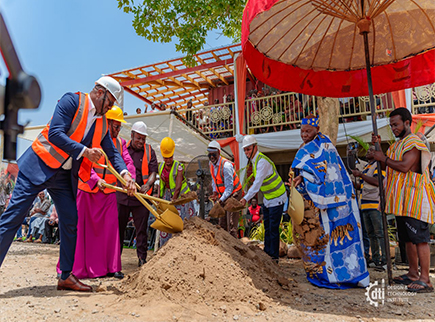
The Design and Technology Institute (DTI) has held a landmark groundbreaking ceremony at Berekuso in the Eastern Region for the construction of its $28 million Multi‑Skills Campus, a facility projected to become one of Africa’s foremost Centres of Excellence in technical and vocational education.
The event drew senior government officials, traditional leaders, industry captains, diplomats, development partners, and academia.
Among the dignitaries were George Opare Addo, Minister for Youth Development and Empowerment and keynote speaker; Mrs. Rita Akosua Adjei Awatey, Eastern Regional Minister; Odeɛfoɔ Oteng Korankye II, Berekusohene; and Osabarima Nana Ansah Sasraku III, Mamfehene.
Founder and President of DTI, Ms Constance Elizabeth Swaniker, described the project as a decisive step in redefining Ghana’s TVET landscape.
She noted that 2026 marks 10 years since DTI was founded, inspired by the skills gap she observed through her metal fabrication firm, Accents & Art.
DTI’s mission, she said, had been to “bridge academia and industry” through hands‑on, industry‑relevant training grounded in the institution’s hallmark philosophy of Precision Quality — accuracy, consistency, integrity, and excellence.
Since admitting its first cohort of 32 students in 2019, DTI has expanded exponentially, achieving more than 48,932 youth trained in TVET and Precision Quality programmes and
Over 81,000 young people employed or transitioned into meaningful work and more than 90 per cent pass rates.
Also, there is over 50 per cent female participation up from 21 per cent, more than 160 industry partners, Precision Quality integrated into seven universities, six campuses nationwide, with over 4,000 applications in 2025 alone.
Ms Swaniker emphasized that a rapidly changing world — shaped by AI, automation, and digitalisation — required Africa to close its skills gap to unlock its demographic advantage.
The new 11‑acre DTI Berekuso Multi‑Skills Campus is expected to train 3,500 learners annually when fully operational. It will serve as a Pan‑African hub for workforce development, instructor training, precision manufacturing, and applied research.
The first phase, supported by a €3 million AU/SIFA grant with financing from KfW and scheduled for completion within 24 months, includes two three‑storey academic blocks, a two‑storey administrative block and 160‑booth welding and fabrication workshop — the largest in Ghana.
Others are advanced non‑destructive testing (NDT) laboratories, industrial anchor factory spaces, student centre and amphitheatre and community-use facilities.
Fidelity Bank Ghana donated $100,000 toward the Student Centre, while the Ghana Ports and Harbours Authority and Modec Production Services Ghana Ltd. donated containers to support construction.
New programmes to be introduced include Industrial Plumbing, Industrial Electrical Systems, Cleaning Science, and Agriculture Mechanisation.
Ms Swaniker expressed deep appreciation to the Berekuso traditional authorities, noting that the campus is being built for the youth of the community and future generations.
As a not‑for‑profit institution, she called for continued partnership through scholarships and bursaries, endowment funds, equipment and technology donations, internship and employment pathways.
“This project is bold and ambitious,” she said. “Let us move from support to partnership.”
Ms Swaniker urged all stakeholders to embrace the “noble and glorious challenge” of building Africa’s future.
“The future of Africa will not be defined by potential. It will be defined by what we build today.”
In his keynote address, George Opare Addo commended DTI’s leadership and described the campus as a long‑overdue investment in Ghana’s human capital.
He highlighted the nation’s paradox, saying “Every year, 300,000 young people enter the labour force. Yet employers still struggle to find skilled talent.”
He reiterated that Ghana’s challenge was not a lack of ambition or intelligence among its youth, but weak bridges between education and industry. DTI, he said, is one of the few institutions successfully closing this gap.
Opare Addo reflected on DTI’s growing national influence — from its Precision Quality Framework, now part of national standards, to its role in shaping
Traditional leaders, including Nana Odeefo Oteng Korankye II, Chief of Berekuso and Twafohene of the Akuapem Traditional Area, Osahene Boafo Ansah III, Krotihene of Akuapem and other representatives of the Muslim and Traditional Union, blessed the project, underscoring its importance to the Berekuso community and the nation.
They emphasized that the land’s stewardship reflected their commitment to education, progress, and youth development.
In remarks delivered at the event, representatives from industry partners — including construction, consulting, and architecture firms — praised DTI’s model of competency‑based, industry‑driven training.
Fidelity Bank’s Managing Director, Julian Kingsley Opuni, highlighted the global skills mismatch, noting that while one billion young people will enter the global workforce in the next decade, only 460 million jobs will be available.
He stressed that DTI’s approach “builds capability, not just credentials,” preparing youth to secure or create meaningful work. Fidelity pledged ongoing support through financial literacy, entrepreneurship training, and access to financial services.