
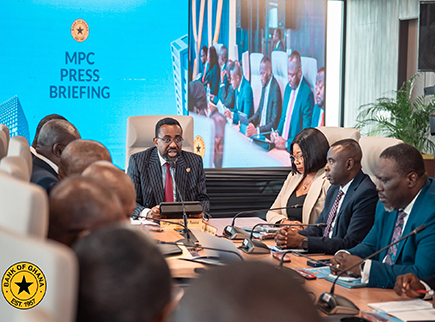
Dr Johnson Pandit Asiama, the Governor of the Bank of Ghana (BoG), said the sector regulator will soon grant licences to financial institutions to start non-interest banking (Islamic banking) operations in the country.
Despite not providing any timelines, he said the Bank was ready to receive and review applications and grant licences to institutions that would meet requirements, noting growing interest in the sector from investors.
He said this at the 128th Monetary Policy Committee (MPC) press briefing in Accra on Wednesday, where a 250-basis points policy rate cut was announced, bringing the rate to 15.5 per cent from the previous 18 per cent.
“A number of potential investors are writing to us and doing the necessary checks. So, we are optimistic that very soon, we may be able to see a formal application for a licence that we can review and take things forward,” Dr Asiama said.
He said progress had been made since the announcement of the operationalisation of non-interest banking last year, with a series of consultations having taken place and a guideline published to steer conducts in the sector.
A non-interest banking is a banking business consistent with established principles of strict avoidance of interest, excessive uncertainty or ambiguity, gambling or speculative transactions resembling chance, and financing of prohibited activities.
For the Central Bank, the establishment of the sector is to support economic growth, deepen financial inclusion, promote sustainable development, and create new jobs, aligning with the Bank’s objectives of price stability, financial stability, and economic development.
Professor John Gartchie Gatsi, Advisor to the Governor on non-interest banking, in November 2025, had said that the regulator was fully prepared to roll out operations for the sector, following the completion of all structural and guideline requirements.
Prof Gatsi reiterate the importance of non-interest banking for Ghana, calling for greater adoption.
He said it was founded on Islamic principles, which provided a system where lending and borrowing occurred without interest and the proceeds shared based on profit and loss agreements.
He had demystified the notion of non-interest banking being a tool to promote Islamic religion, but an avenue to raise alternative funds to develop its economy, particularly Small and Medium-sized Enterprises (SMEs) without the burden of interest payments.
“If you go to the US, UK and Malaysia it is there as an alternative banking. Most secular economies have Islamic banking as part of their structure. So that is what we should be aspiring to have in the country, to augment what we have, to promote other areas that we are not able to promote,” he said.
Although the Banks and Specialised Deposit-Taking Institutions Act, 2016 (Act 930) has made provisions for non-interest banking in Ghana, due to interest in the sector, it was until 2025 that a framework to guide operations in the sector was formalised.