
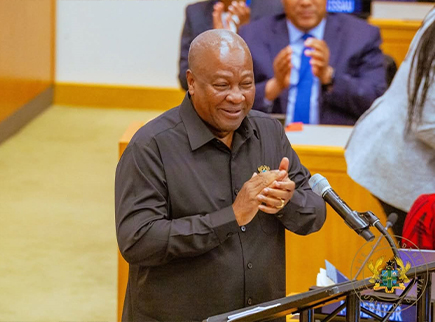
President John Dramani Mahama has underscored the moral urgency of confronting historical injustices and advancing a global commitment to reparatory justice.
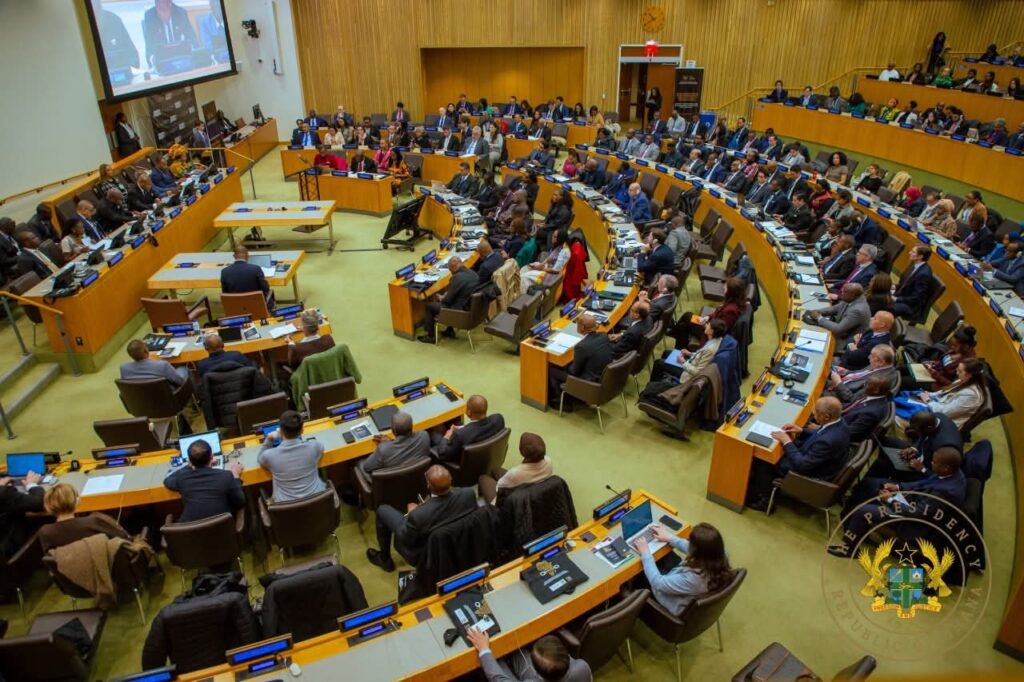
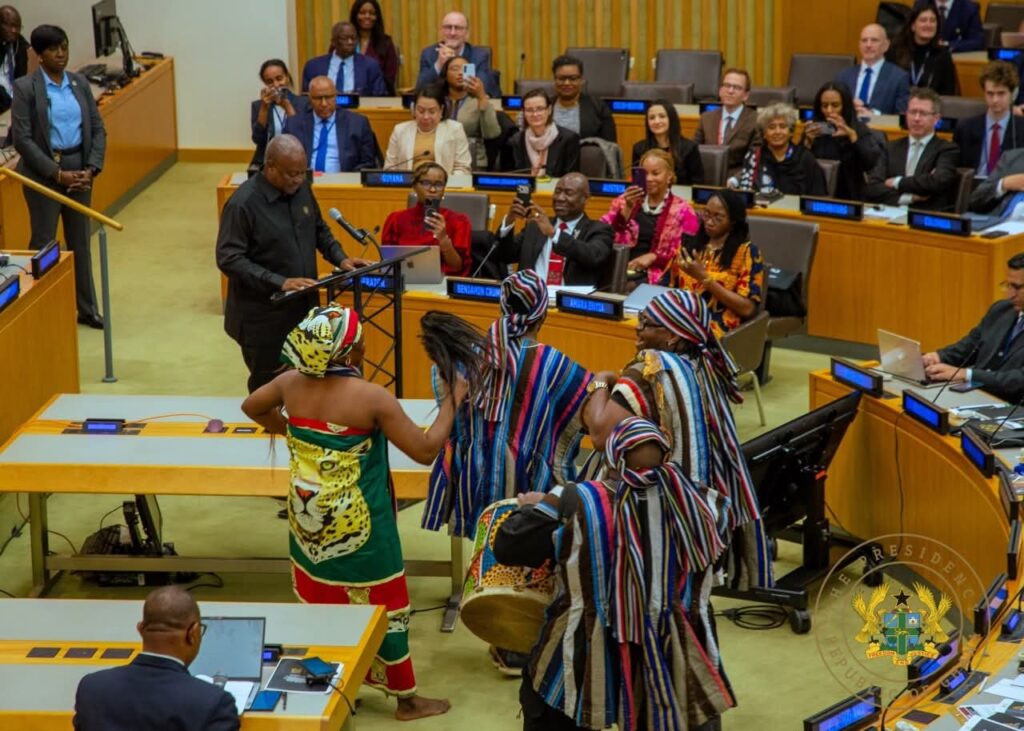
He made the appeal in his address at a High-Level Event on Reparatory Justice for the trafficking of enslaved Africans and the racialised chattel enslavement of African people, convened at the United Nations Headquarters, New York.
President Mahama said truth begun with language, which was the power that words held to shape consciousness, shift perspective, and propel action.
“I therefore offer this truth as a starting point: There is no such thing as a slave. There were human beings who were trafficked and then enslaved by people who believed they could own those human beings as chattels, as their personal property,” he said.
He said the entire transatlantic slave trade was designed to deny African people their humanity and that the denial was premised on a racial hierarchy with no basis in fact or science, but a system that deemed whiteness as superior and blackness inferior.
President Mahama said the atrocities that were committed against enslaved Africans, the myriads of injustices that were borne of slavery and carried forward into successive social frameworks, took place specifically because they were considered as objects.
“Therefore, when discussing slavery and its resulting institutions and practices, we must always start by reclaiming racial equality, the dignity of Africans, the humanity of our ancestors who were enslaved and, as a matter of course, our own humanity,” the President said.
He said “Recently, someone asked me to explain the importance of the resolution on the declaration of the trafficking of enslaved Africans and racialised chattel enslavement of Africans, as the gravest crime against humanity.”
President Mahama explained that the resolution allowed them, as a global community, to collectively bear witness to the plight of the 18 million men, women, and children whose homes, communities, names, families, hopes, dreams, future, and lives were stolen from them over the course of four centuries.
“I speak these words today not only for Ghana, but also in solidarity with the rest of Africa, the Caribbean, Latin America, the wider Diaspora and, all people of good conscience throughout the world. This resolution is a pathway to healing and reparative justice. This resolution is a safeguard against forgetting,” he stated.
The President said violence begun with language, meaning; when words were used as weapons, or to codify abuse, and when people were called out of their names.
He noted that regardless of their state of dress when they were captured, enslaved Africans were always stripped of their clothing while being kept in the dungeons of the fortresses, that had been built by the Europeans.
President Mahama said they were forced, with their limbs chained and shackled onto the cargo hold of a ship and they remained naked, packed like sardines, during the months-long journey through the Middle Passage.
“Not all those who were loaded onto the ships survived the voyage. Several of the ships sank, and many of the enslaved jumped overboard, choosing certain death to captivity,” he said.
The President stated that between 10 to 15 per cent of enslaved people died in the Middle Passage explaining further that “Whenever a ship arrives at its destination, the enslaved people, still naked, were taken to the slave market, where they were inspected and appraised, like livestock.”
He said they were then placed on an auction block in front of an audience of potential buyers and sold to the highest bidder; adding that once they were on the plantation where they would work and live, they were stripped of their names.
“No longer Fatou, Bubakar, Kofi, Nana Yaw, Emeka, Nahnyong or Hamisu; they were given names like Ben, Jemima, Toby, or Mary,” and they were also called “girl,” or “boy,” regardless of their age, he said.
“If a surname was ever needed, it would be that of their master. Sometimes they were even branded, like cattle, with the plantation’s insignia or logo.”
He said at the time, there were sugar, coffee, cotton, tobacco, and cocoa plantations in the Caribbean and the Americas, while South America had diamonds and gold mines as well. The production of indigo also took place in Jamaica and the people who were enslaved laboured on those plantations from sunrise to sunset.”
President Mahama stated that the conditions under which they worked were brutal as some were beaten, occasionally to the point of death, they were underfed, kept in cramped quarters, and they often died young, if not from the labour then from diseases.
He noted that although some enslaved women were turned into breeders, in many of these places, the deaths far outnumbered the births.
“Just because everybody is doing something doesn’t make it right. Slavery is wrong now, and it was wrong then,” he stated.
He reiterated that for as long as Africans had been trafficked and enslaved, there had been abolitionists who had spoken up against it.
President Mahama urged the international community to back the call for Reparatory Justice for Africans and People of African Descent.