
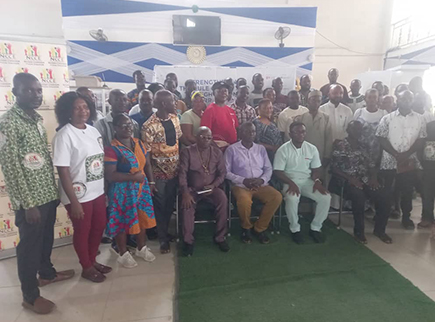
Mr Seth Sabah Serwornoo-Banin, Awutu-Senya East Municipal Chief Executive (MCE) has called on the new executive members of the Municipal Social Auditing Committee to work assiduously to the benefit of the Municipality.
He urged them to work together to promote the interest of people living in the Municipality and Ghana as a whole.
Mr Serwornoo-Banin, made the call at a social auditing engagement organised by the Municipal Directorate of the National Commission for Civic Education (NCCE) for identifiable groups and other stakeholders at Kasoa.
The engagement on the theme: “Strengthening the Rule of Law and the Fight against Corruption,” coincided with the formation of the Committee for Awutu-Senya East Municipality.
It was to enhance participant’s capacity to lawfully demand transparency and accountability from duty bearers, strengthen dialogue and collaboration between citizens, duty bearers and oversight institutions and to improve their understanding of local government operations, the rule of law and public accountability mechanisms.
It aimed also to increase awareness on where to lodge complaints, seek redress on maladministration, as well as to strengthen dialogue and collaboration between communities, duty bearers, oversight institutions, and to increase community participation in monitoring public projects and service delivery.
The meeting brought together Traditional authorities, Assembly Members, representatives from civil society organizations, the Christian Council, Muslims, the Assembly and Departments and agencies.
Issues of bad bridges, faulty sewage systems, educational infrastructure, health delivery, local economic development, suspected corruption among duty bearers, bad roads, electricity and stalled projects were deliberated upon with calls on duty bearers to work to fix them.
The MCE who was a special guest, said some of the projects which was tabled for deliberation were already in their 2026 budget and work on some of them had started.
He assured all that the other projects would be included in their mid-year budget review for consideration.
Mrs Mary Ankah, Awutu-Senya East NCCE Director, earlier in her address said Social Auditing offered a practical and participatory approach at strengthening the demand side of public accountability, It empowers communities to assess development projects and track the use of public resources.
According to her, through Social Auditing platforms, citizens were enabled to identity gaps in policy implementation, assess service delivery outcome and together develop action plans with local authorities.
She said this approach did not only strengthen accountability, but also promoted inclusive decision-making and shared responsibility for development outcomes.
“The NCCE is implementing Social Auditing meeting in 60 districts to deepen civic engagements, strengthen public accountability and enhance citizens participation in governance on the project dubbed “civic engagement on the rule of law and the fight against corruption,” under the Participation, Accountability and Integrity for a Resilient Democracy (PAIRed) programme.”
The progamme commissioned by the German Federal Ministry for Economic Cooperation and Development (BMZ) and co-financed by European Union (EU) and the Swiss State Secretariat for Economic Affairs.”
She said the project was key because corruption remained one of the greatest threats in Ghanaian society, particularly to local governance and national development and urged the citizenry to be patriotic and help combat the canker.
Ms Victoria Ofosuah Peprah, a Director from the Office of Commission on Human Rights and Administrative Justice (CHRAJ), took participants through various types of corruption, their effects on institutions and the nation at large and how to report corruption to the appropriate institutions for action.
She taught them the whistleblowers act, 2006 (Act 720), which provides legal frame for individuals to disclose information about unlawful or corrupt practices in the public interest and how to join social media campaign to raise wider awareness.
Ms Peprah stated that Act 720 helped citizens to report people in authority or persons indulging in wrongdoing to protect the country’s public resources, stop corruption early before it happened to help build a better and fairer Ghana.
Corruption she noted, continued to be a canker, impeding the developmental progress of the country, with its impact extensively visible.
She mentioned abuse of entrusted power for private and personal gains, bribery, fraud, embezzlement, nepotism, extortion and conflict of interest as examples of corruption.