
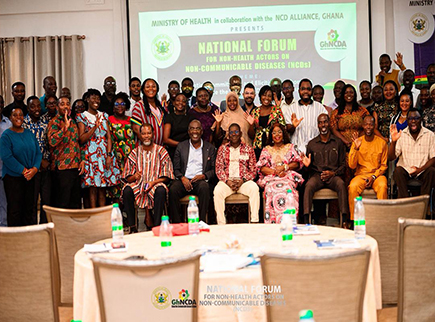
Mr Labram Musah, the National Coordinator of the NCD Alliance, Ghana says the time has come for non-health actors to support in reducing the rising burden of non-communicable diseases (NCDs) in the country.
He said there was the need for non-health actors to integrate NCD prevention into sector/institutional policies, plans, and budgets to promote physical activity, healthy meals, regular screening and mental health services.
He said this would help improve the health of the workforce and prevent absenteeism at the workplace and premature mortality while ensuring economic growth of businesses.
Mr Musah who is also the Executive Director of the Vision for Accelerated Sustainable Development, Ghana gave the advice at the National Forum for Non-Health Actors on Non-communicable Diseases (NCDs) held in Accra.
The forum was on theme: “Creating Commitment and Eliciting Collaboration to Reduce the Rise in NCD Burden in Ghana.” It was organised by the Ministry of Health in collaboration with the Ghana NCD Alliance.
Mr Musah during a presentation on “CSOs Perspective on National NCD Response: Strategic Entry Point for Non-Health Sector Engagement and Investment,” noted that high cost of NCD treatment affected households’ education, housing, and investment and weakened national development outcomes across sectors.
He pointed out that early prevention reduced long-term government expenditure on treatment, which protected fiscal space for infrastructure, education, and social protection, among others.
He said dwindling donor support funding to the health sector fell from 19 per cent to just 2.2 per cent, creating an annual funding gap of more than GH¢2.4 billion (President Mahama).
Mr Musah said NCDs represented 74 per cent of all deaths globally and 45 per cent of mortality in Ghana, and that the diseases epidemic in the country was driven by social, economic, and environmental factors outside the health sector.
He noted that the rapid urbanization had
changed food environments, adding that, “Street vendors, fast-food outlets, and supermarkets are concentrated in cities, providing easy access to unhealthy food.”
He mentioned other factors as aggressive marketing of unhealthy products – tobacco, alcohol, sugar/energy drinks, ultra-processed products, prevalence of cigarettes, shisha, e-cigarettes use, limited spaces for physical activities within the cities, and exposure to polluted air.
Mr Musah said, “The time to lead is now! A Healthier Ghana is a Stronger Ghana. A unified effort is required to address the NCD crisis and build a healthier, more resilient nation for all Ghanaians.”