
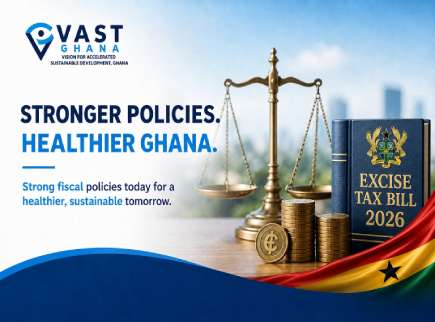
The Vision for Accelerated Sustainable Development Ghana (VAST- Ghana), a civil society organisation has commended Parliament for the successful passage of the Excise Tax Bill 2026 as a strategic instrument for protecting public health.
It said the passage of the legislation marked another important milestone in Ghana’s journey towards using fiscal policy not only as a revenue mobilisation tool, but also as a strategic instrument for promoting responsible consumption and strengthening sustainable domestic financing for health.
“We express our profound appreciation to the Ministry of Finance for the proposed reforms to the excise tax regime,” it stated
The VAST-Ghana in a statement copied to the Ghana News Agency said the passage of the Bill demonstrated strong political leadership and a growing recognition that well-designed health taxes were among the most cost-effective interventions available to governments.
“This reform aligns with global recommendations from the World Health Organisation, which continues to advocate for stronger health taxes under its ‘3 by 35 Initiative,’ – a call for countries to raise the real price of tobacco, alcohol, and sugar-sweetened beverages by at least 50 per cent by 2035 through excise tax increases, thereby reducing affordability and generating sustainable domestic resources for health,” it stated.
The statement noted that non-communicable diseases (NCDs) now accounted for nearly half of all deaths in Ghana (45 per cent) and placed significant pressure on the country’s health system, workforce productivity, household incomes, and national economic development.
It said the treatment of cardiovascular disease, cancer, diabetes, chronic respiratory disease, and other NCDs consumed substantial healthcare resources that could otherwise be invested in preventive health services and broader development priorities.
It therefore said fiscal measures that discouraged the consumption of health-harming products represented one of the smartest investments Ghana could make.
“VAST Ghana welcomes the decision to reform the excise tax structure for spirits, shifting from a purely ad valorem system, to a hybrid structure that combines specific and ad valorem tax rates,” it stated.
The statement added that “This is an important public health achievement as evidence from countries such as Thailand and the Philippines shows that hybrid excise taxes are more effective than ad valorem taxes alone in reducing alcohol consumption.”
It noted that by raising the price of the cheapest products often consumed by lower-income groups, young people, and heavy drinkers, hybrid taxes helped reduce consumption of unhealthy products, while limiting the industry’s ability to shift consumers toward lower-taxed alternatives.
The VAST-Ghana encouraged the Government to extend the hybrid excise tax structure beyond spirits to cover all alcohol beverages, including beer, wine, ciders, and ready-to-drink alcohol products.
“A consistent taxation approach across all alcohol categories would create a more coherent tax system, minimise harmful product substitutions, and maximise both public health and revenue outcomes,” it stated.
It recommended that Ghana introduce a minimum unit pricing policy for alcohol in future reforms – an effective complementary measure that prevents the sale of extremely cheap alcohol and works alongside excise taxation to reduce alcohol-related harm.
The statement urged the Government to establish robust regulatory and monitoring mechanisms to prevent abuse of any remaining exemptions.
It said VAST-Ghana remained concerned that the Excise Tax Bill 2026 retained excise tax on electronic cigarettes.
“Ghana’s Public Health Act, 2012 (Act 851) and the Tobacco Control Regulations, 2016 prohibit the manufacture, importation, advertisement, sale, and distribution of electronic cigarettes and related products for recreational use,” it stated.
It said a product that was prohibited should not simultaneously appeared within the country’s excise tax framework.
“Removing electronic cigarettes from the excise tax schedule would strengthen regulatory consistency, reinforce enforcement efforts, and eliminate opportunities for the tobacco industry to misrepresent taxation as evidence of legal market acceptance.
The VAST-Ghana reiterated its call on the Government to consider earmarking a meaningful portion of health tax revenues to finance NCD prevention, health promotion, screening, and health system strengthening.
It added that, “Dedicated financing will help ensure that the dual benefits of reduced harm and increased revenue are fully realised.
“The passage of the Excise Tax Act 2026 demonstrates that Ghana continues to recognise the importance of health taxes as an essential component of sustainable development.
“The reforms adopted represent meaningful progress and provide a strong foundation upon which future improvements can be made,” it stated.
The statement said VAST Ghana remained committed to supporting and collaborating with Government, CSOs, academia, development partners, and regulatory agencies to ensure that Ghana’s excise tax system evolved in line with international best practice and delivered maximum health, social, and economic benefits for all Ghanaians.