
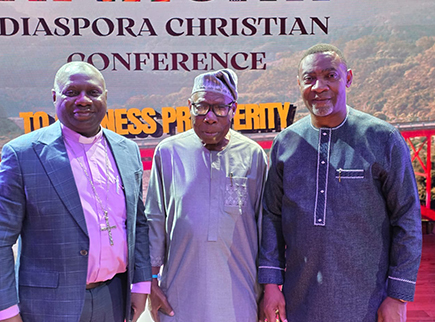
The Reverend Canon Dr Lawrence Tetteh, President of the World Miracle Outreach, has called for urgent and deliberate efforts to promote reconciliation across Africa and its Diaspora.
He described it as a critical pathway to addressing leadership failures, ethnic divisions and persistent mistrust that continued to hinder the continent’s development.
Delivering a plenary address at the AFReG 5 African Diaspora Christian Conference (ADCC) in Montego Bay, Jamaica, he said Africa’s challenges were not primarily due to a lack of resources or ideas, but rather a deficit of unity, trust and shared identity.
The conference, held on the theme “Building Bridges to Oneness, Prosperity, and Generosity,” brought together African and Diaspora Christian leaders to explore collaboration and development strategies.
He pointed to ongoing conflicts across Africa, including tensions in the Sahel, the Great Lakes region and other parts of the continent, noting that many of these crises were rooted in unresolved divisions among leaders and communities.
Citing South Sudan as an example, Rev Canon Dr Tetteh said despite independence and international support, the country continued to face instability largely due to leadership divisions.
He said the global environment also reflected deep fractures, referencing humanitarian crises in Sudan, governance breakdown in Haiti and polarised immigration debates in Western countries as evidence of a world increasingly divided.
“The world does not need more information. It needs reconciliation. And reconciliation needs people who have first been reconciled themselves,” he said, adding that Africa and its Diaspora had a unique role to play in bridging global divides.
Rev Canon Dr Tetteh noted that reconciliation must begin with individuals, including leaders, before extending to institutions and nations.
He outlined three levels of reconciliation — with God, with oneself and with others — explaining that unresolved identity crises and internal conflicts often manifested in broader societal divisions.
Rev Canon Dr Tetteh said Africa continued to grapple with the legacy of slavery, colonialism and distorted narratives that had shaped perceptions of identity and self-worth.
“There is a violence that leaves no visible scar, and yet it may be the most devastating of all — the violence done to identity,” he said.
He said overcoming these challenges required confronting false narratives about Africa, including perceptions that the continent was hopeless or dependent on external aid.
Rev Canon Dr Tetteh highlighted Africa’s economic potential, referencing the African Continental Free Trade Area (AfCFTA) and the continent’s youthful population as indicators of future growth.
He urged participants to take practical steps towards reconciliation, including engaging in honest dialogue, addressing historical grievances and building partnerships across ethnic, national and generational divides.
“You cannot build bridges to others from a self that is at war with itself. The reconciled leader is first a reconciled person,” he said.