
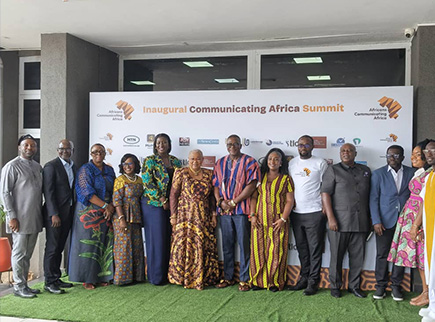
African communicators have been urged to reclaim the continent’s narrative from negative, crisis-driven and stereotypical portrayals that continue to impose profound psychological and economic costs on Africa and its people.
Professor Audrey Sitsofe Gadzekpo, a communication expert, at an Inaugural Communicating Africa Summit on Tuesday, said the persistent depiction of Africa through the lenses of poverty, conflict, coups, famine and corruption had entrenched colonial-era stereotypes, weakened the continent’s global image and contributed to billions of dollars in avoidable borrowing costs annually.
She said the “poverty porn” framing of Africa in sections of the western media had dehumanised Africans, robbed many young people of their dignity and reinforced a colonial mentality that shaped how Africans viewed themselves and their continent.
“Every story of violence, coups, election upheaval, famine and corruption carries a price tag,” Prof Gadzekpo said, stressing that Africa’s portrayal as a high-risk investment destination continued to influence international credit rating agencies and global investors.
Africa pays as much as 4.2 billion dollars yearly in avoidable interest payments because of negative perceptions perpetuated in global media narratives, she noted, addingthat reclaiming that narrative was an economic and developmental imperative to influence investment flows, global partnerships and the confidence of future generations.
Prof Gadzekpo said single stories often reduced Africa to one-dimensional depictions while ignoring the continent’s democratic gains, innovation, resilience and cultural richness.
She urged African communicators to critically examine the stereotypes they themselves perpetuated about race, class, religion, gender and nationality and find solutions not by replacing one incomplete story with another, but by multiplying perspectives and experiences.
She said digital platforms, data journalism, podcasting, documentary filmmaking and artificial intelligence offered transformative opportunities in reshaping Africa’s global image, adding that artificial intelligence could aid African communicators in language translation, automated fact-checking, investigative data analysis and multimedia storytelling.
Prof Gadzekpo called for increased African participation in the design, governance and training of AI systems, including investments in African language datasets and local technological capacity.
“The most powerful technology we possess is not artificial intelligence, it is the ancient, irreplaceable human technology of a story told with courage, precision and love for the people at its centre,” she stated.
Togbe Kwasinyi Kakaklolo Agyeman V, Communication for Social Change Advocate, said the Communicating Africa Summit must help shape language, image, memory and public discourse across the continent.
“The work ahead of us is patience. It is the careful editing of Africa’s stories across a thousand newsrooms, hundred ministries, ten thousand classrooms and million phones. It is choosing the right word. But to speak well, we must first listen well. Listen to the elder in the room and the teenager on the timeline,” he noted.
The Reverend Dr Joyce Aryee, Executive Director, Salt and Light Ministries, who was the Chairperson for the Summit, said the African story must be told accurately with courage and precision.
“We owe it to our generation and the generations ahead of us to change the narrative, say the truth and not to split it,” she added.