
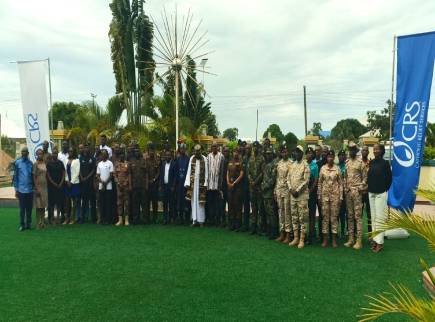
Catholic Relief Services (CRS) has intensified efforts to strengthen collaboration between civilians and security agencies to prevent violent extremism in Ghana through its Prevention of Violent Extremism through Social Accountability (PoVETSA) II Project.
The initiative is being implemented by CRS in partnership with the National Peace Council and the Kofi Annan International Peacekeeping Training Centre (KAIPTC), with funding support from the Netherlands Ministry of Foreign Affairs.
As part of the project, the partners organised a five-day workshop in Wa aimed at building the capacity of civilian and security actors to enhance coordination and collaboration while fostering resilient communities against violent extremism.
The workshop brought together personnel from security agencies in the region, representatives of civil society organisations (CSOs), religious leaders, youth groups, and other stakeholders.
Speaking at the opening of the workshop, Ms Adelaide Yiriyelleh, PoVETSA Project Manager at CRS, stressed that maintaining peace and security is a collective responsibility that requires a whole-of-society approach.
She explained that the training was designed to strengthen partnerships between communities and security institutions in promoting peace and security through the prevention of violent extremism.
“A key outcome is to build the capacities of both civilians and security sector actors towards enhancing collaboration in the long run, especially in building community resilience, because we understand that ensuring peace and security is a collective responsibility,” Ms Yiriyelleh stated.
Mr Frank Wilson Bodza, Director in charge of Conflict Management and Resolution at the National Peace Council, noted that despite Ghana’s strong preventive measures against violent extremism, mistrust between communities and security agencies could undermine those efforts.
“One of the things that we have identified is that there is a trust gap from the side of civilians against the security agencies and the security agencies also against the civilians,” Mr Bodza said.
He explained that the training sought to address this trust deficit, which is critical to preventing violent extremism.
According to him, the workshop aims to bridge the gap by promoting professional, respectful and constructive engagement between civilians and security agencies in advancing peace and security.
Mr Bodza added that the training complements the “See Something, Say Something” campaign, which encourages public vigilance and the reporting of suspicious activities to strengthen Ghana’s resilience against the threat of violent extremism.
The training is being conducted across all five regions of Northern Ghana and focuses on modules that enhance participants’ understanding of civilian-security engagement while promoting peace and security.