
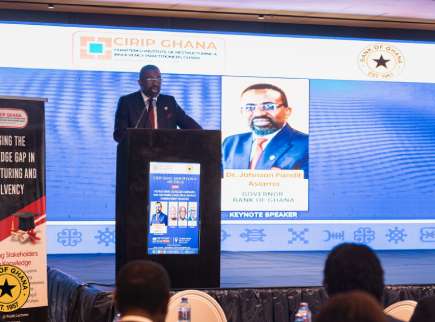
Dr Johnson Pandit Asiama, Governor of the Bank of Ghana (BoG), has proposed the establishment of a Business Rescue Fund to provide financing for distressed but viable businesses and support economic activity.
The proposed fund would operate within a predictable financing framework that enables banks and other financial institutions to extend credit to eligible businesses without undermining their balance sheets or financial stability.
Dr Asiama made the proposal at a forum on restructuring distressed companies, non-performing loans (NPLs) and post-commencement financing, co-organised by the BoG and the Chartered Institute of Restructuring and Insolvency Practitioners (CIRIP).
He said many firms encountered cash-flow constraints because of external shocks, including high interest rates, delayed payments, foreign exchange volatility and disruptions arising from the COVID-19 pandemic, rather than weaknesses in their core business models.
Dr Asiama said the failure of otherwise viable businesses reduced employment, tax revenue and Gross Domestic Product (GDP), arguing that a dedicated rescue fund would help preserve productive capacity, supply chains and creditor recoveries.
“A dedicated Fund can provide working capital so they can retain employees, buy inputs, and
complete contracts. Without it, productive capacity is destroyed and creditors recover less,” he said.
The Governor said proposals under consideration included funding the facility through unclaimed depositor funds, government budgetary allocations and private sector contributions.
“The private sector, at the end of the day are the beneficiaries, so they can also contribute to it. So, we are in the boat together,” he emphasised.
Dr Asiama said the central bank would support the initiative beyond its regulatory mandate.
He said although the Corporate Insolvency and Restructuring Act, 2020 (Act 1015), provides a legal framework for restructuring distressed but viable businesses, financing remained a major constraint to successful business rescue.
Referring to the banking sector restructuring that resulted in the closure of nine universal banks, Dr Asiama said the experience underscored the need for a disciplined rescue framework with clear governance, accountability and oversight arrangements that would protect financial stability while preserving viable enterprises.
He urged banks to assess applications for rescue financing on the basis of credible financial information, competent management, transparent governance and sustainable cash flows, and called for closer collaboration among banks, insolvency practitioners and other stakeholders to establish a predictable, risk-sensitive restructuring framework.
Dr Ishmael Yamson, Chairman of the occasion and Board Chair of Scancom PLC (MTN
Ghana), said Act 1015 was intended to promote business restructuring rather than liquidation by allowing distressed but viable companies to recover.
He said the law accorded post-commencement financing super-priority over other claims to support business continuity, preserve employment and maximise recoveries for creditors.
Dr Yamson proposed excluding post-commencement financing from NPL calculations and loan growth restrictions during a defined rescue period.
He called for additional financing through specialised distressed debt funds, syndicated facilities with development finance institutions, partial credit guarantee schemes and targeted tax incentives.
“The primary objective should be to equip enterprises to manage finances soundly, so they don’t fall into distress. This means stronger early-warning frameworks, dedicated workout units in banks, and better coordination between the BoG, insolvency practitioners, and CIRIP Ghana.
“Rescue must harmonise prudence with recovery: protect depositors, but also ensure a rescuable Ghanaian company gets a fair, supervised chance to survive and meet its obligations,” he emphasised.