
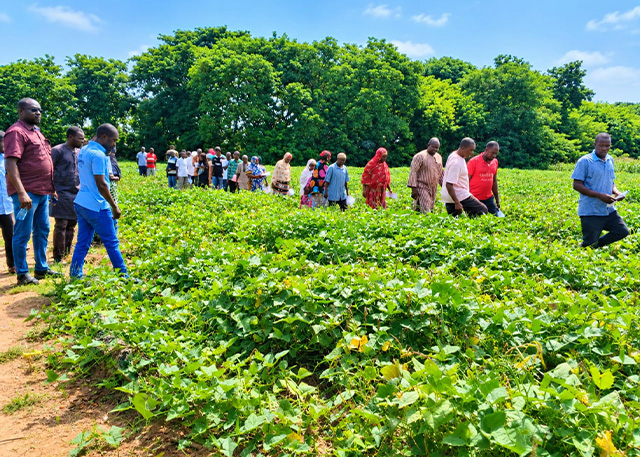
The Council for Scientific and Industrial Research-Savanna Agricultural Research Institute (CSIR-SARI) has engaged farmers in the Upper West Region, in the selection of cowpea breeding materials to give them a voice in determining preferred cowpea varieties.
This was through a Participatory Varietal Selection (PVS) exercise, held at the CSIR-SARI Wa Station, which brought together farmers from four communities in the Wa Municipality, agricultural extension personnel and researchers to evaluate 15 promising cowpea candidate lines alongside five check varieties.
The exercise formed part of the Cowpea Breakthrough Project, implemented by CSIR-SARI with funding from the Gates Foundation through the International Institute of Tropical Agriculture (IITA).
Farmers observed the materials under field conditions and selected the genotypes they considered most desirable based on characteristics that matter to them as producers, consumers and market participants.
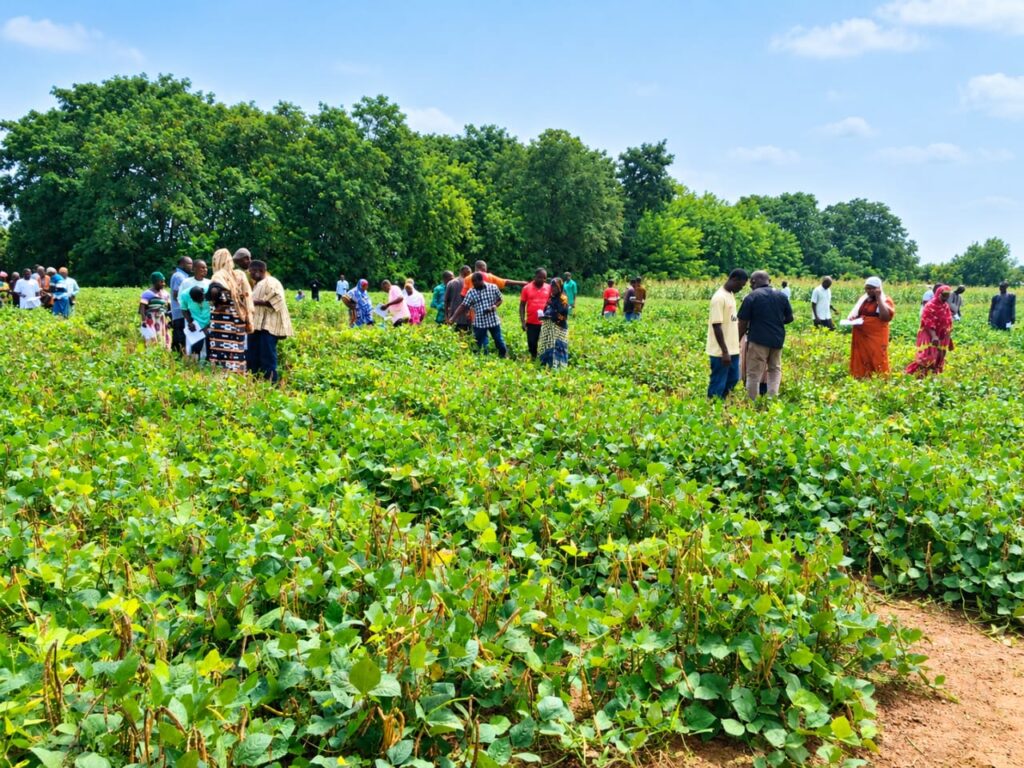
Leading the exercise, Dr Theophilus Kwabla Tengey, a Senior Research Scientist and Lead Cowpea Breeder at CSIR-SARI, said the farmer’s participation was necessary because the ultimate users of the varieties were the farmers themselves.
Dr Tengey explained that the candidate materials had undergone several years of breeding and multi-location evaluation before being presented to farmers for their assessment and selection.
He said the materials represented different breeding objectives, including drought tolerance, resistance or tolerance to charcoal rot, Striga and insect pests, early and medium maturity, large seed size and desirable seed colors, among other characteristics.
Dr Tengey noted that a similar PVS exercise conducted in 2020 contributed to the advancement of promising materials that were subsequently approved and released in 2022 as SARI-tuya and Tuzievallenga.
The two varieties have since been adopted by farmers in the Upper West Region and other parts of Northern Ghana, providing an example of how farmer preferences can contribute to the development and advancement of varieties that reach farming communities.
Dr Iddrisu Yahaya, the Head of Division at CSIR-SARI, Wa Station, said farmer participation was essential to improving the prospects for adoption of improved varieties.
He noted that uniform maturity was one of the characteristics influencing farmers’ selections because it could allow farmers to harvest a crop more uniformly, potentially reducing the number of harvesting operations.
Dr Yahaya encouraged farmers to take advantage of opportunities to learn about and adopt improved agricultural technologies developed through research to improve productivity, livelihoods, and incomes.
Dr Peter Quandahor, an Entomologist at CSIR-SARI, Wa Station, who facilitated the PVS exercise, highlighted the importance of breeding cowpea varieties with resistance or tolerance to major insect pests.
He explained that entomologists work closely with breeders to screen breeding materials for resistance or tolerance to important insect pests as part of efforts to develop varieties that can perform better while reducing farmers’ dependence on chemical pesticides.
Dr Quandahor maintained that incorporating pest resistance or tolerance into improved varieties could, therefore, help reduce production costs while contributing to safer food production and a healthier environment.
Dr George Mahama, an Agronomist at CSIR-SARI, Wa Station, stressed that the benefits of improved varieties could only be fully realized when farmers applied appropriate agronomic practices.
He urged farmers to pay attention to proper planting, timely weed control, and appropriate fertilizer application throughout the production cycle.
For the cowpea improvement team, the objective is to develop varieties that perform well in farmers’ fields and varieties that farmers want to grow.