
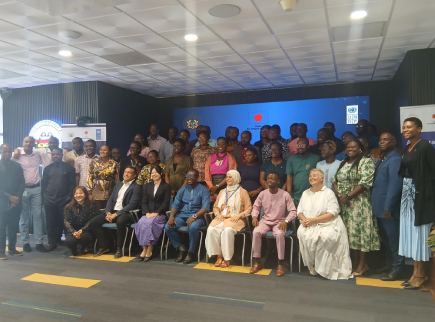
Fifty government officers are undergoing a three-day training programme to strengthen their capacity to champion artificial intelligence (AI), digital innovation and improved public service delivery.
The programme, organised by the Ministry of Communications, Digital Technology and Innovations in partnership with the United Nations Development Programme (UNDP), with funding from the Government of Japan, seeks to equip public officials to identify institutional challenges and apply digital solutions to improve efficiency.
The participants, drawn from various Ministries, Departments and Agencies (MDAs) are receiving training in systems thinking, digital government, data governance, AI adoption and procurement, and digital public infrastructure.
They are also expected to identify operational bottlenecks, assess data gaps and develop practical technology-driven solutions to improve institutional performance.
Speaking at the opening in Accra on Monday, Ms Shaima Hussein, Deputy Resident Representative of UNDP Ghana, said the initiative would help bridge the gap between Ghana’s digital infrastructure and its capacity to translate technological advances into improved public services.
She said Ghana had laid a strong foundation through initiatives such as the Ghana Card, interoperable payment systems and Ghana.gov, but needed to strengthen institutional capacity to use data and AI effectively.
“What we need to support here is a local solution,” she said, stressing the need for digital systems that addressed national priorities and respected the country’s sovereignty.
Ms Hussein said responsible AI adoption required strong institutional capacity, effective data governance and ethical safeguards to ensure public officials could assess AI solutions, protect public data and remain accountable for decisions informed by the technology.
She said the training would help participants identify institutional barriers and data gaps, while an AI accelerator component would support the development of practical use cases through problem identification, risk assessment and responsible experimentation.
The UNDP and the Ministry would convene a strategic dialogue to examine digital governance priorities and develop an integrated digital and AI portfolio across government, Ms Hussein said.
The initiative aims to certify 50 government officers as Digital and AI Champions, while strengthening the capacity of 40 chief directors and 120 directors to commission, procure, govern and lead digital initiatives.
Mr Emmanuel Ofori, Director of Innovations at the Ministry, said AI should be viewed as a strategic decision-making tool rather than the exclusive responsibility of information technology professionals.
“AI is for decision making. It’s a decision making or decision support technology. It is not IT,” he said.
He said Ghana had made significant progress in digital transformation through digital government services, national digital identification and interconnected mobile money services, but the next phase required a coordinated, problem-driven approach rather than isolated projects.
Mr Ofori urged participants to identify operational bottlenecks, improve data use and explore how digital technologies could address challenges in their institutions.
“The success of this programme will be measured by what changes because you were here,” he said, urging participants to return to their institutions with practical ideas and the confidence to question processes that could be improved.
Madam Izumi Kume, Coordinator for Economic Cooperation at the Embassy of Japan, said the support reflected Japan’s confidence in Ghana’s efforts to advance digital transformation and modernise public administration.
She said investment in public institutions was essential to achieving sustainable results, urging participants to share their knowledge with colleagues and translate it into tangible improvements in public service delivery and Africa’s broader digital transformation.