
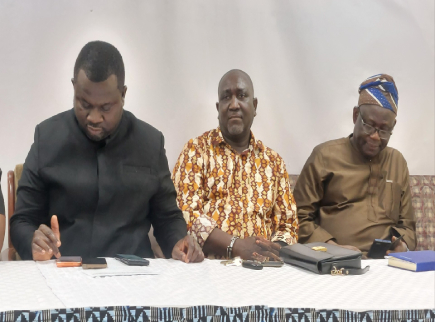
The Ghana Journalists Association (GJA) has expressed concern over the increasing involvement of uniformed personnel in attacks on journalists, warning that such incidents threaten press freedom and undermine public accountability.
Mr Albert Dwumfuor, President of the GJA, said several reported attacks on journalists involved personnel of the police, military and other security agencies, raising concerns about the safety of media practitioners covering public interest issues.
He made the remarks at a GJA press briefing to mark the International Day to End Impunity for Crimes Against Journalists, a United Nations-sanctioned event observed annually on November 2.
The theme for this year’s observance is: “Threats Evolve, Impunity Persists.”
He said the Association had recorded more than 50 incidents of attacks, assaults, arrests, threats and harassment of journalists since 2022.
Five attacks were recorded in January 2026 alone, three of which allegedly involved state security personnel, he said.
Mr Dwumfuor cited incidents involving journalists covering the Council of State elections, suspected illegal mining activities in the Western Region, security situations in Bawku and Walewale, and demolition exercises at the Labadi and Laboma beaches in Accra.
Other incidents included the alleged assault of three journalists by police officers in April 2025, an attack on journalists at the Economic and Organised Crime Office in May 2025, and the assault of Class FM journalist Samuel Addo by fire service personnel in 2026.
He also cited the alleged assault of Obrempongba Benjamin Kwame Owusu, a journalist with Adom News, Adom TV and FM, by military personnel deployed to enforce a curfew in Nkwanta South in the Oti Region.
The GJA President said although the Association acknowledged arrests and disciplinary actions in some cases, such measures must lead to transparent investigations and appropriate sanctions or prosecution where evidence supported them.
“Promises of investigations alone are not justice,” he said.
He called on the Inspector-General of Police and the Police Administration to treat attacks on journalists as serious offences and establish a dedicated focal point for receiving complaints and providing updates on investigations.
“No individual should be shielded from accountability because of their uniform, rank, political affiliation or public position,” he said.
Mr Dwumfuor also urged the Ghana Armed Forces, Ghana National Fire Service, National Security and other security institutions to cooperate with investigations, preserve evidence and sanction personnel found culpable.
He said the Association was renewing its call for a national journalist safety framework, a rapid response mechanism and a dedicated system to address attacks on media practitioners.
The proposed framework, he said, would provide clear protection protocols and facilitate emergency assistance, legal support, medical care and psychological support for journalists who suffered attacks.
He further called on the Government to provide resources for effective investigations, while urging the Attorney-General and prosecutorial authorities to prioritise cases involving attacks on journalists and the courts to ensure their fair and timely determination.
Professor Amin Alhassan, the Director-General of the Ghana Broadcasting Corporation (GBC), also called for expedited police investigations and quicker judicial determination of cases involving attacks on journalists.
He said several cases remained unresolved and urged the relevant institutions to ensure that perpetrators were brought to justice.
“We want to appeal that we should all understand that this is not a favour to journalists, but it is an important marker of our national development, that we should be able to promote a certain culture of tolerance and acceptance, that good journalism must be protected,” he said.
Professor Alhassan said attacks on journalists were an assault on democracy and the fundamental freedoms enjoyed by citizens.
He stressed that protecting journalists was a national development responsibility rather than a favour to the media profession.
Mr George Sarpong, the Executive Secretary of the National Media Commission (NMC), warned that economic and political pressures could expose journalists to increased restrictions and threats in the coming year.
He said societal restrictions on the press tended to increase in proportion to the level of stress, threats or crises experienced by society, citing the proposition of scholar Frederick Seibert on press freedom.
Mr Sarpong identified the possibility of drought, food shortages and food inflation, alongside political tensions associated with the approaching pre-election period, as factors that could heighten pressure on journalists.
“Next year is going to be very, very critical for journalists and journalism in terms of our safety,” he said.
He urged media stakeholders and relevant authorities to anticipate potential threats and strengthen engagements to address them before they escalated into crises.
Mr Sarpong said active journalism, particularly reporting that questioned powerful interests, often exposed practitioners to attacks.
“The only time people attack journalists is when they are raising questions that matter to society, but powerful people do not want those questions raised,” he said.
He said quality journalism that held public officials and institutions accountable required effective systems and rules to protect practitioners.