
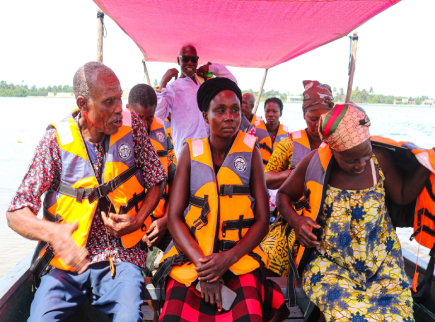
Boat operators and passengers have expressed differing views on life jacket use, with some describing the equipment as essential for survival while others cite discomfort, cost and confidence in swimming abilities as reasons for reluctance.
The differing attitudes present a challenge to efforts to promote safety on inland waterways, where the Ghana Maritime Authority (GMA) is implementing the “No Life Jacket, No Boarding” policy to protect passengers and boat operators.
For Mr Joshua Nyavor, a boat operator, wearing a life jacket is non-negotiable, insisting that passengers who refuse to wear one should not be allowed to board.
He said the equipment was necessary because emergencies could occur unexpectedly, and even people who could swim might panic when a boat capsized or they fell into the water.
“You may know how to swim, but in times of emergency you may panic. You also don’t know when an incident will occur,” he said.
Mr Nyavor said he did not charge passengers separately for using life jackets, adding that operators only collected the normal transport fare.
He, however, said the availability of enough life jackets remained a challenge and suggested that a small adjustment in transport fares could help operators acquire additional equipment.
He also expressed concern that although regulations required passengers to wear life jackets before boarding, enforcement remained a challenge, allowing some operators to carry passengers without them.
At Kponkpo Kpanya, another boat operator, Mr Raymond Akuerter, popularly known as Eze, said some passengers resisted wearing life jackets but complied when compelled by operators and safety personnel.
He said the presence of the GMA and the Ghana Navy at the landing site had strengthened enforcement.
Mr Akuerter, however, admitted that he did not wear a life jacket himself, explaining that he relied on empty plastic gallons as flotation aids in an emergency.
He acknowledged that the practice was unsafe but said the cost of life jackets made it difficult for him to acquire additional ones after purchasing them for passengers.
He appealed to the GMA to help make the equipment more affordable so that operators could acquire enough for themselves and their passengers.
Mr Salabobo Winner Tordzie, a fisherman, said although fishermen understood the importance of life jackets, some were reluctant to wear them because they could swim and believed the equipment restricted their movement during fishing activities.
He said the reluctance among fishermen to wear life jackets could also influence their attitude towards requiring passengers to use them.
At Adafoewem Kpanya, Mr Doe Ametepe, a Safety Guard, said personnel were working to ensure that all passengers wore life jackets before boarding boats.
He said the guards also checked the condition of the jackets to ensure that they were suitable for use.
Mr Ametepe said some passengers complained that the jackets were smelly, uncomfortable or had weak foam, making them doubt their effectiveness.
He said the guards continued to educate passengers and insist on compliance, sometimes having to compel reluctant users to wear the equipment properly.
Passengers who refused to comply were not allowed to board, he said, stressing that the policy was intended to prevent avoidable drowning incidents.
For Ms Eva Hagan, a passenger, wearing a life jacket is an important precaution whenever she crosses the river.
She said although she did not travel by boat daily, she personally requested a life jacket whenever she needed to make the journey.
“Travelling on the river is risky. If you wear it and the boat has an accident, at least it can help save you if you fall into the water,” she said.
Another passenger, Ms Wornaame, said she had understood the importance of wearing life jackets and believed that anyone who refused to comply should not be allowed to board.
She said passengers needed to appreciate that the equipment was intended to protect their lives.