
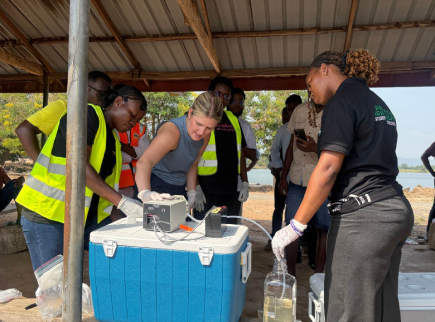
A delegation of United States (US) scientific experts has visited Ghana to strengthen cooperation on water resource protection, mercury pollution monitoring, and sustainable mining practices, amid concerns over contamination of freshwater systems by illegal small-scale mining.
The delegation, comprising experts from the US Department of the Interior, the US Geological Survey (USGS) and the US Environmental Protection Agency (EPA), was in the country from November 7 to 21 under the Ambassador’s Water Experts Programme (AWEP), a joint initiative of the US Departments of State and the Interior.
A statement issued by the US Embassy, said during the visit, the experts held technical consultations with Ghana’s Environmental Protection Agency (EPA) on water quality, mercury contamination, and the development of laboratory capacity.
It said discussions focused on the threat posed by mercury pollution to freshwater systems affected by illegal small-scale gold mining, otherwise known as “galamsey”, as well as the need for standardised testing methods and stronger scientific collaboration between the two countries.
The visit built on a 2024 baseline assessment conducted by Dr Grace Armstrong, a USGS scientist and former Embassy Science Fellow, which identified elevated mercury levels in water and sediments in the Pra and Ankobra river systems.
Dr Armstrong, the statement said, returned to Ghana as part of the delegation and participated in engagements aimed at strengthening the country’s capacity to monitor mercury contamination and generate reliable scientific data for environmental decision-making.
A major component of the visit was a two-day symposium held from November 10 to 11, on the theme: “Addressing Mercury Pollution: Collaborative Solutions for Sustainable Mining in Ghana”.
The symposium brought together US and Ghanaian experts, civil society organisations, academic institutions and industry stakeholders to examine the environmental, health and security implications of mercury use in mining.
It also provided a platform to showcase practical and commercially viable mercury-free mining technologies as alternatives to the use of mercury in gold extraction.
Dr Armstrong said addressing mercury pollution required coordinated scientific approaches and trusted partnerships.
“Our work together helps ensure that data collected in Ghana meets rigorous standards and supports effective decision-making for environmental protection,” she said.
Mr Rolf Olson, then Chargé d’Affaires ad interim of the US Embassy in Ghana, said protecting the country’s freshwater resources was essential to environmental and public health, as well as long-term economic and food security.
“The United States is committed to working with Ghana to strengthen scientific capacity, advance responsible mining practices, and promote American technological solutions that support sustainable development,” he said.
Dr Chris Eckley, a US EPA expert, said drawing on US experience in assessing and remediating mercury-contaminated sites could help Ghanaian counterparts address local environmental challenges.
The delegation also engaged academic institutions, civil society organisations and youth groups, including students from the University of Ghana, the Kwame Nkrumah University of Science and Technology, the University of Environment and Sustainable Development, and the Accra STEM Academy.
The engagements focused on raising awareness about water protection and exploring opportunities for training, field research and scientific collaboration.
The initiative also seeks to strengthen analytical quality assurance, expand local scientific expertise and support the adoption of international best practices in water quality monitoring and mercury detection.
The visit comes as Ghana and the United States approach 70 years of diplomatic relations, highlighting their cooperation on environmental protection and other challenges affecting public health, security and economic development.