
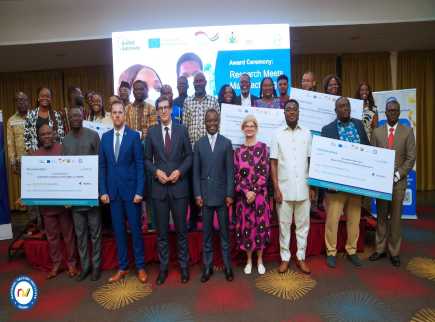
Eight grants valued at EUR 2 million have been awarded under the PharmaVax Ghana programme to support innovative partnerships between Ghanaian research institutions and pharmaceutical companies in vaccine and pharmaceutical research and development.
The grants, with complementing technical assistance, are to help researchers and manufacturers translate scientific discoveries into practical health solutions for the local and regional markets.
The initiative is jointly funded by the German Federal Ministry for Economic Cooperation and Development (BMZ) and the European Union (EU).
The eight projects were selected through a competitive Call for Proposals jointly organised by the National Vaccine Institute (NVI) and the Deutsche Gesellschaft für Internationale Zusammenarbeit (GIZ).
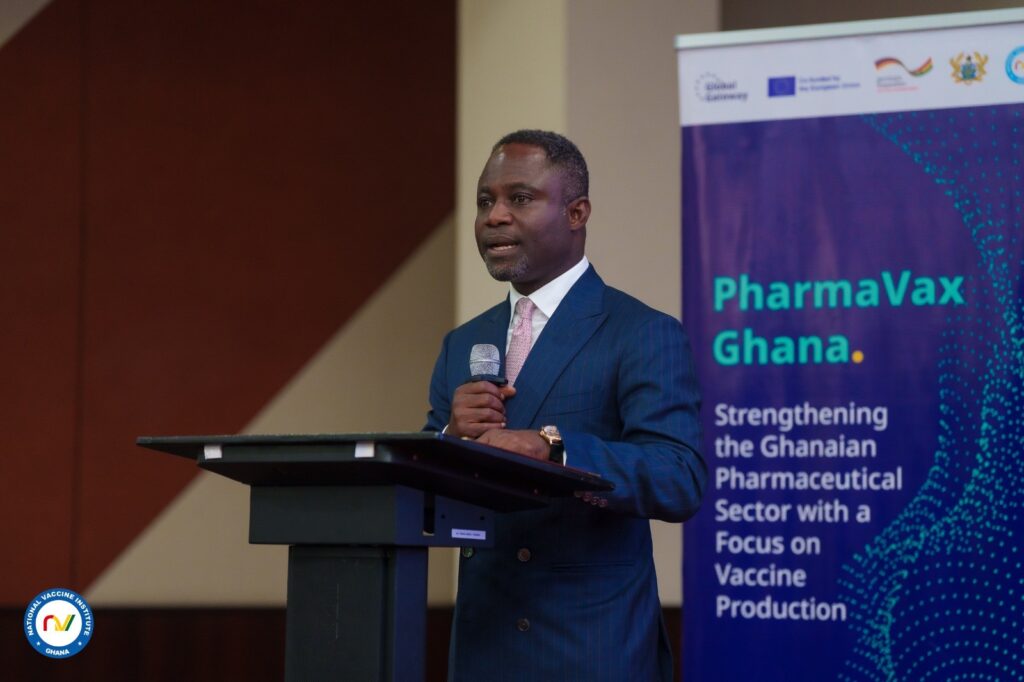
They range from developing child-friendly malaria medicines and plant-based therapies for chronic diseases to applying artificial intelligence (AI) to accelerate antibody discovery for malaria and Mpox.
Ghanaian partners are contributing an additional EUR 425,000 towards the implementation of the projects, demonstrating their commitment to advancing locally driven health innovation.
Beyond financial support, the beneficiaries will receive technical assistance, networking opportunities and knowledge exchange to strengthen research capacity and promote the commercialisation of the products.
The grants were presented during the “Research Meets Manufacturing” Award Ceremony co-hosted by the NVI and GIZ under the PharmaVax Ghana Programme.
Mr Kwabena Mintah Akandoh, the Minister of Health, Mr Frederik Landshöft, the Ambassador of the Federal Republic of Germany to Ghana, Mr Jonas Claes, Chargé d’Affaires and Head of Political Section, European Union Delegation to Ghana, as well as representatives from government institutions, universities, pharmaceutical companies and the wider scientific community were present.
Mr Akandoh said the projects marked the beginning of an important journey.
He said: “A journey that brings researchers, manufacturers, government and international partners together to transform scientific discoveries into medicines and vaccines that save and improve lives.”
Dr Sodzi Sodzi-Tettey, Chief Executive Officer of the NVI, highlighted the importance of connecting Ghana’s research excellence with local manufacturing capabilities.
“Ghana has the scientific talent, the research institutions and an increasingly capable pharmaceutical industry to develop health solutions that respond to our own priorities,” he said.
Dr Sodzi-Tettey said: “By bringing these strengths together, we are creating the foundation for medicines and vaccines that are developed in Ghana, manufactured in Ghana, and have the potential to benefit the wider region.”
The grants contribute to Ghana’s vision of building a resilient pharmaceutical sector, strengthening health security and expanding local manufacturing capacity for medicines and vaccines as a strategic industry for economic development.
The Kwame Nkrumah University of Science and Technology, in partnership with the Aspee Pharmaceuticals Limited and the Ghana Atomic Energy Commission, has been awarded EUR 300,000 in grant funding, complemented by EUR 150,000 in own contributions, to optimise a locally developed herbal pain medicine for scalable and sustainable local manufacturing.
The University of Cape Coast, in collaboration with Kash Chemist Limited, received EUR 100,000 in grant funding, with an additional EUR 10,000 in own contributions to develop a fast-dissolving oral tablet for the treatment of malaria in children, improving accurate dosing and treatment adherence.
The Noguchi Memorial Institute for Medical Research, University of Ghana, together with Atlantic Lifesciences Limited, secured EUR 500,000 in grant funding and EUR 47,000 in own contributions to generate stability data to support regulatory approval and strengthen the reliable local production of tetanus-diphtheria vaccines and tetanus antitoxin.
The Council for Scientific and Industrial Research – Water Research Institute, working with Kantanka Herbal Pharmaceuticals and Research Centre Limited, was awarded EUR 125,000 in grant funding, alongside EUR 20,000 in own contributions to generate scientific evidence on the safety and effectiveness of herbal treatments for alcohol-related liver disease while supporting their scale-up for local production.
The Centre for Plant Medicine Research is implementing two projects in partnership with the Dodowa Health Research Centre and Atlantic Lifesciences Limited, supported by EUR 340,000 in grant funding and EUR 37,000 in own contributions, to evaluate the safety and efficacy of an affordable locally developed herbal product for prostate health through a clinical trial and generate stability data to support regulatory approval of a locally produced snake venom antiserum with an extended shelf life.
The West African Centre for Cell Biology of Infectious Pathogens at the University of Ghana, in collaboration with the DEK Vaccines Limited, mPharma Health AI Labs Limited and INCAS Diagnostics and Services Limited, was awarded EUR 300,000 in grant funding, with EUR 40,000 in own contributions, to use a Ghanaian AI platform to design and scale up monoclonal antibodies and diagnostics for Mpox and malaria, while strengthening local manufacturing capacity.
The Central University, in partnership with Ernest Chemists Limited, has received EUR 250,000 in grant funding and would contribute EUR 30,000 towards the development and validation of a standardised herbal treatment for hypertension, preparing it for large-scale local production.
An independent committee of nine Ghanaian experts evaluated the 43 project proposals received against criteria including technical merit, public benefit, involvement of a local manufacturer and the long-term sustainability of the proposed research and development work beyond the project duration.
The PharmaVax Ghana programme, by fostering collaboration between research institutions, industry and public sector stakeholders would contribute to building a sustainable ecosystem for vaccine and pharmaceutical manufacturing in Ghana.