
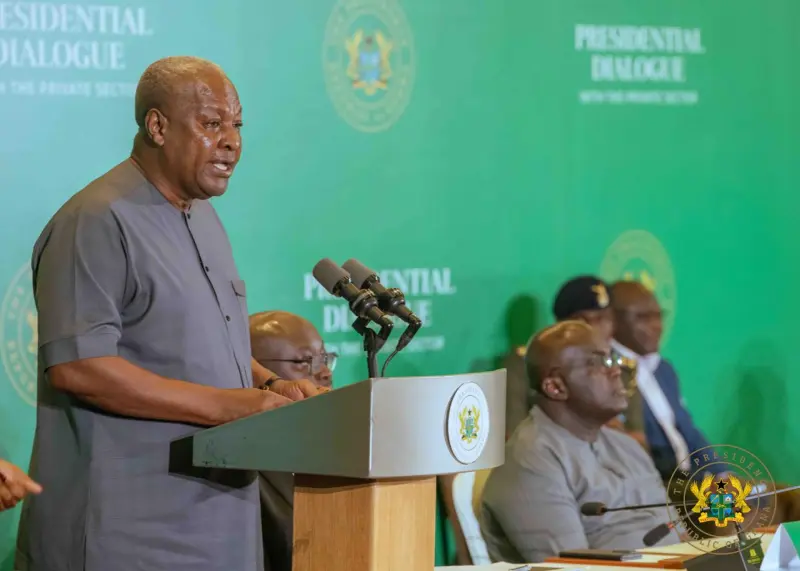
President John Dramani Mahama on Monday held his maiden Presidential Dialogue with the Private Sector, seeking to define a conversation in Ghana’s industrial and economic transformation.
Speaking at the Dialogue in Accra, President Mahama recalled that in the run-up to the 2024 election, he made a firm promise that if Ghanaians entrusted him with their mandates, he would hold an annual Dialogue with Captains of Industry and Business to address the challenges hindering the growth of the private sector in Ghana.
“A promise made, a promise kept. I have convened this Presidential Dialogue with the private sector because I hold a simple but firm conviction that Ghana’s economic transformation is a joint enterprise.”
He noted that the Government could not achieve it alone and that equally, the private sector could not thrive without a government that listens, reforms and creates an enabling environment for businesses to thrive.
“Tonight is about resetting that partnership between government and the private sector. And we must do this candidly, substantively and with mutual accountability,” he said.
The President acknowledged the extensive sector engagements undertaken by Mrs Elizabeth Ofosu-Adjare, the Minister of Trade, Agribusiness and Industry over the past year.
He said those consultations from exporters’ roundtables to factory visits and market engagements had grounded their policy direction in practical reality.
He noted that Ghana’s economy had emerged from a period of severe turbulence.
“We are beginning to see positive signals, relative stabilisation of the currency, improved investor sentiments, strengthened business confidence, new private capital investments in manufacturing and processing,” the President said.
“These outcomes reflect deliberate fiscal consolidation, value-added tax rationalisation, removal of distortionary levies and a determined effort to restore macroeconomic credibility. But let me be clear, stabilisation is not equal to transformation.”
President Mahama said for over five decades, Ghana’s manufacturing sector had contributed around 10 per cent to gross domestic product (GDP).
He said meanwhile, emerging Asian economies, starting from a similar basis, had achieved manufacturing shares of 20 per cent to 30 per cent of GDP and thereby created mass employment and export competitiveness.
“And so we need to change our trajectory. I therefore set a national target. Manufacturing must contribute at least 15 per cent of GDP by the year 2030, supported by 500,000 new quality industrial jobs. This will require structural reform and not incremental adjustments,” the President said.
He said, he took note of the Ghana Chamber of Mine’s recent report that said Ghana was losing competitively in investments to Benin, the Ivory Coast and Nigeria.
The President said there were many areas they needed to look at, as outlined in the report.
He mentioned that areas like corporate taxation, electricity tariffs and stable power, duties on machinery and equipment, and several others.
“Across every sub-sector represented here tonight, one constraint dominates. That is the cost of energy and reliability of power. Industrial tariffs in Ghana remain uncompetitive relative to our regional peers.”
The President said no industrial nation thrives under structurally high costs of power.
He noted that his administration would accelerate energy sector debt restructuring, expand generation capacity, particularly in renewables, introduce differentiated off-peak industrial tariffs, improve transmission efficiency, and promote embedded generation in industrial enclaves.
Adding that: “Energy reform is not optional. It is foundational to Ghana’s industrial take-off. The same applies to water supply for manufacturing. We must reform the water sector and include private sector participation in the supply of industrial water.”
He said while interest rates were falling sharply from the highs of about 38 per cent a few years ago, industrialization could not take off when interest rates remain around 18 to 20 per cent and lending turnovers are quite short term.
The President said they could resolve these challenges by establishing dedicated financing windows for manufacturing, partner with the Bank of Ghana, and development finance institutions, develop special purpose vehicles for Small and Medium Enterprises (SMEs) industrial expansion, expand credit guarantee schemes, and deepen long-term capital markets instruments.
He reiterated that access to affordable patient capital would be treated as a structural reform priority by the Government.