
Professor Kwesi Amponsah-Tawiah, an Occupational Health Psychologist, has underscored the need for the leadership of mine support service companies to integrate mental health into their risk management strategies to build a healthy psychosocial culture at their workplaces.
According to him, such a move would ensure a positive working environment for employees and prioritise their wellbeing and safety for enhanced productivity.
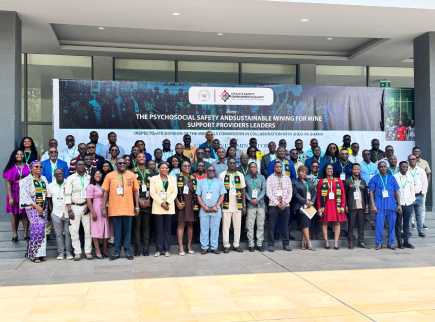
He said this when the Safety, Health, Environment and Quality Practitioners Association of Ghana (SHEQPA-GH) in collaboration with the Inspectorate Division of the Minerals Commission (MinCom) organised an executive seminar for leaders and stakeholders of support service providers in the mining industry.
The seminar, held in Takoradi, was on the theme: “The psychosocial safety and sustainable mining for Mine support providers leaders.”
Participants were sensitised on leadership strategies for building positive and healthy workplace cultures, effective contract management, and the relevant provisions of the mining regulations and their application to contractors and business partners.
Prof Amponsah-Tawiah noted that psychosocial risks at work were not soft issues and had profound human and economic consequences.
According to him, data from the International Labour Organisation (ILO) revealed that globally, about 840,000 employees’ death linked to psychosocial risks at work were recorded annually, with about 1.37 per cent of global GDP also lost each year due same issue.
He stated that micromanaging or withholding autonomy, inconsistent employee recognition, one-way communication, and applying rules unfairly were some leadership behaviours that gave rise to workplace and psychosocial risks and eroded employee wellbeing.
He, therefore, encouraged participants to shape their organisational culture and behaviour by inspiring confidence, motivate their people, improve upon performance, and foster healthy and productive workplaces.
Madam Akua Agyeiwaah Berantuo Armooh, the President of SHEQPA-GH, said the association recognised that most major mining companies had established systems and structures to support the wellbeing of their employees, but, some contractors and business partners had limited or, in some cases, no comparable systems in place.
She said: “Often, these organisations do not adopt the practices of their parent companies because they perceive them as costly or difficult to implement.
“As a result, situations arise where some contractor employees struggle to access basic personal protective equipment, lack health insurance coverage, do not receive paid time off, and have no formal channels for reporting workplace harassment.”
She added that in some instances, employees faced intimidation for raising safety concerns, work excessively for long hours that led to fatigue and burnout, experienced delays in salary payments, and had little opportunity for recognition or support.
Madam Armooh noted that it was against this background that the SHEQPA-GH and MinCom organised the seminar to explore ways to collectively support contractors and business partners in understanding and addressing these critical gaps.
She said preventing psychosocial risks required commitment, collaboration and shared responsibility from all stakeholders, and asked the government to continue to strengthen policies, legal frameworks, and occupational safety and health systems that supported prevention.
Mr Joseph Frimpong, the Acting Chief Inspector of Mines at MinCom, said issues like excessive work pressure, fatigue, poor communication, weak leadership, and workplace conflict among others could adversely affect workers’ well-being and ultimately lead to unsafe acts and incidents.
He encouraged participants to recognise that psychosocial health was not just a human resource concern, but also a critical component of occupational health and safety, operational performance, and business sustainability.
“Leadership must, therefore, cultivate an environment where employees feel safe to speak up, report hazards, challenge unsafe decisions, and share ideas without fear of retaliation,” he added.