
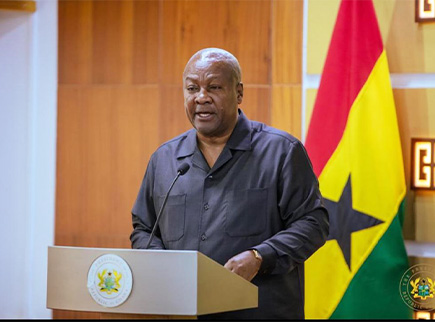
Accra, Feb. 26, 2026 – President John Dramani Mahama is expected to emphasise the Government’s plans to consolidate economic gains and report progress on key national initiatives when he delivers the State of the Nation Address (SONA) to Parliament on Friday, February 27.
The 2026 SONA, the President’s second since the commencement of his second term on January 7, 2025, will offer government a platform to account for its stewardship and set out priorities for the year ahead.
Under Article 67 of the 1992 Constitution, the SONA provides a constitutional framework for the President to review the country’s socio-economic performance and outline policy direction to Parliament and the nation.
The address comes at a time when Ghana continues to navigate economic challenges, fiscal adjustments and the delivery of flagship programmes introduced since the President assumed office following the National Democratic Congress’ victory in the 2024 general election.
It will also set the tone for parliamentary and national discourse on strategic government interventions across key sectors.
Significance of the SONA
The State of the Nation Address is among the most significant events on Ghana’s political calendar because of the opportunity it offers for comprehensive assessment of national performance, key policy interventions and planned reforms.
It is closely watched by lawmakers, the private sector, civil society and the public for insights into government strategy on economic management, job creation, social services delivery, and public sector reforms.
In previous years, the SONA had not only served as a report card on government commitments but also highlighted emerging challenges and provided direction on legislative priorities.
The 2026 address will be particularly important as the NDC Administration assesses progress on measures introduced in the 2025 address and other major policy initiatives.
Reflection on Last Year’s Address
On February 27, 2025, President Mahama outlined several interventions in the SONA, aimed at stabilising the economy, improving public services and laying foundations for long-term growth.
Analysts noted that the address set a roadmap for economic reset and recovery after Ghana faced mounting fiscal pressures and structural constraints.
On the economy, the President highlighted measures to restore fiscal discipline and strengthen debt management.
His administration had already reduced the size of government ministries and streamlined staff at the Presidency as part of expenditure control.
The Domestic Debt Exchange Programme was being honoured, and an MoU with the Official Creditor Committee had been signed to formalise debt treatment.
Recognising the strain on the energy sector, the President announced reforms to address the GH¢70 billion debt in state-owned utilities.
He directed structural changes including a single revenue collection account and strict adherence to the Cash Waterfall Mechanism to improve efficiency and financial sustainability.
Education and youth empowerment were also central issues captured in the President’s address.
The government pledged to eliminate the double-track system in Senior High Schools and expand STEM and TVET programmes to better equip students for global competitiveness.
A no-fee stress policy for tertiary admissions, supported by an enhanced Student Loan Plus Scheme, was introduced to lower barriers to higher education.
Social Sector and Agriculture
In the social sector, President Mahama reaffirmed commitments to improving by healthcare access and complete key infrastructure projects.
He acknowledged challenges in the health system, including the need to finish hospital infrastructure under the Agenda 111 initiative and mitigate funding disruptions caused by changes in external aid support.
The agricultural sector was highlighted as essential for food security and employment.
The government rolled out the Agriculture for Economic Transformation Agenda (AETA) and related programmes such as the Feed Ghana initiative and Nkoko Nkitinkiti poultry project to reduce food imports and generate jobs for rural households.
Looking Ahead
As President Mahama prepares to deliver the 2026 SONA, expectations are high for a detailed account of progress on those initiatives and further measures to consolidate economic gains.
The address, to be broadcast live, will bring his policy direction directly to Ghanaians and invite stakeholders to engage with the government on plans for sustained growth and development.