
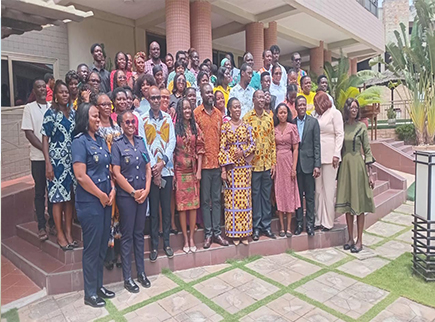
Takoradi, April 24, GNA – TradeMark Africa (TMA), a leading Aid-for-Trade organisation, in collaboration with the Ghana National Chamber of Commerce and Industry (GNCCI), has built the capacity of women- and youth-led small and medium-sized enterprises (SMEs) to enable them become export-ready.
The initiative, which took the form of a two-day training workshop, exposed participants to the rudiments of the export market and demystified the perception that exporting was only for large-scale businesses.
Participants were educated that any legally registered enterprise that meets international trade standards and specifications could access export opportunities.
The training was held on the theme: “Enhancing the Export Competitiveness of Ghanaian SMEs through Strengthened Institutional Capacity.”
Madam Emelia Assiakwa, Vice President of the GNCCI in charge of Women and Youth, said SMEs were the backbone of Ghana’s economy, yet many continued to face barriers in accessing regional and global markets.
“Our SMEs are the backbone of Ghana’s economy, yet too many face barriers when trying to access regional and global markets,” she said.

She noted that frameworks such as the African Continental Free Trade Area (AfCFTA), the interim Economic Partnership Agreement (EPA) and the Ghana–UK Trade Arrangement had created new opportunities for local businesses.
“But to walk through them, our businesses need the right knowledge, tools and institutional support,” she added.
Madam Assiakwa said the women-led businesses would be equipped with practical skills in export readiness, trade finance, market entry strategies, Incoterms, export documentation, and certifications such as FDA, GSA, HACCP and ISO.
She said participants would also benefit from a Product Registration Clinic, where Customs officers were available to inspect and pre-approve products for key trade agreements.
Describing the workshop as more than just a training session, Madam Assiakwa said it reflected GNCCI’s and TMA’s commitment to moving SMEs from potential to performance.
“We want you to leave here with clear action plans that translate into actual exports, jobs and foreign exchange for Ghana,” she said, urging participants to actively participate, ask questions and network.
Dr Stephen Oteng took participants through trade finance for SMEs and encouraged them to develop sound business plans, realistic budgets and maintain financial discipline to grow their businesses.
Madam Paulina Abrokwah, Chief Executive Officer of TradeLinks Logistics, cautioned participants against common mistakes in exporting and advised them to engage relevant professionals and institutions for guidance.
“You can’t assume you know everything. Ask questions, find out about documentation requirements in receiving countries, conduct proper market research, sign sales contracts and ensure a strong online presence,” she said.
Mr Jonathan Debrah, an independent consultant and trade facilitation expert, and lead consultant for the 12-month project, said women needed the requisite capacity to actively participate in cross-border trade.
“What we are doing is to take them through trade agreements, benefits under the ECOWAS Trade Liberalisation Scheme and other international opportunities to ensure inclusiveness of women-led businesses in trade,” he said.
He explained that the project was informed by a knowledge gap analysis, adding that although women played a critical role in Africa’s economy, limited access to finance and markets continued to impede their growth.
Founded in 2010, TradeMark Africa seeks to grow intra-African trade, increase Africa’s share in global trade and make trade more inclusive, pro-poor and sustainable.
Since its establishment, TMA has played a significant role in transforming trade and regional integration, particularly in East Africa and the Horn of Africa.