
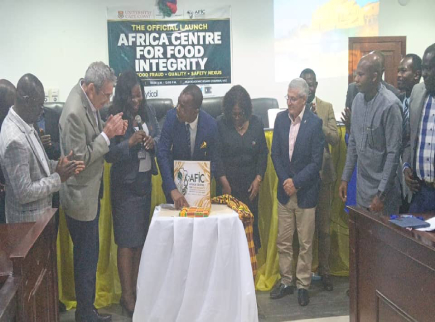
The University of Cape Coast (UCC) has inaugurated the Africa Centre for Food Integrity (AFIC) to address food safety and quality challenges in Ghana and Africa.
The centre seeks to research and develop mobile digital technologies enabled by artificial intelligence (AI) to assess the quality of food in real-time to strengthen food quality assurance and protect food systems against deliberate contamination and food fraud.
Established by the College of Agriculture and Natural Sciences (CANS), the hub will collaborate with key stakeholders, including the Food and Drugs Authority (FDA), the Ghana Standards Authority, farmers and other universities, to protect public health, safeguard livelihoods and strengthen trust in food trade.
Food fraud is the deliberate adulteration or misrepresentation of food often for financial gain, potentially endangering public health.
In Ghana, for instance, some food fraud activities include adulterating palm oil with Sudan IV dye, mixing ginger powder with sawdust, combining cola nuts with powdered pepper, and adding flour to groundnut paste while presenting the products as pure or organic.
In this regard, the AFIC is already developing AI-powered technologies that would mimic the five human sense organs namely ear, nose, tongue, eye and skin to authenticate food safety and quality.
Reverend Professor Ernest Teye, Agri-Food Integrity expert and Centre Lead, explained that the centre was conceived some nine years ago in response to concerns about endemic food contamination, adulteration and food fraud in parts of Africa.
He said the canker was difficult to fight especially with the cumbersome and time-consuming conventional food-testing methods, prompting the development of more advanced technologies.
With the introduction of a mobile-enabled spectroscopic device, for instance, the centre is now able to assess the safety and quality of palm oil within seconds instead of days or weeks.
Prof. Teye announced that the centre had developed a cocoa passport system to trace cocoa beans to their place of production and was also preparing to introduce Spice Check, a technology to authenticate spices consumed in Ghana.
Beyond technology development, he indicated that the centre would also educate consumers about food fraud, particularly the importance of checking food labels and verifying product safety.
He said the AFIC’s ultimate goal was to ensure that food consumed by the public was safe, authentic and sustainable, thereby protecting public health and supporting sustainable development.
“All the Sustainable Development Goals (SDGs) will go nowhere if we cannot have a sustainable food system because food is the foundation of every SDG and so we must look at food first,” he stressed.
Prof. Rofela Combey, Provost of CANS, assured that AFIC would work with farmers, scientists, industry players, educators, policymakers and regulators to ensure food produced, sold and consumed in Ghana and across Africa was safe.
She, therefore, called for collective responsibility in promoting food safety and protecting the quality of food for present and future generations.
Prof. Chris Elliott, a food safety expert with the Queen’s University Belfast, UK, emphasised the need for Africa to urgently address food safety risks, food fraud and trade barriers to unlock its vast agricultural potential and increase its share of global food exports.
Despite holding about 60 per cent of the world’s uncultivated arable land, he observed that Africa accounted for less than four per cent of global food exports.
According to him, projections suggested that the continent’s food export could rise to 25 per cent with continued agriculture expansion and modernisation as well as increased investment and improved infrastructure.
However, contaminated products, counterfeit and expired foods, poor sanitary conditions, high post-harvest losses, regulatory bottlenecks and slow customs procedures remained major barriers to trade.
“Food security is no longer simply an agricultural challenge for Africa. It is a strategic imperative that demands sustained investment in science, technology, trusted global partnerships and resilient supply systems to safeguard future prosperity and stability,” the speaker said.
Professor Christine Adu-Yeboah, Pro Vice-Chancellor of the University of Cape Coast (UCC), said AFIC would become a continental hub where governments, regulators, industry players and researchers could access knowledge, expertise and technology to protect food integrity.
“Food integrity is ultimately about trust; trust that what is labelled is what is contained and when we have labels, whose language we cannot read and understand, then it becomes problematic.
“We also need to trust what is sold. We should trust that what is sold is safe. We should trust that farmers and legitimate businesses are not disadvantaged by fraud,” she said.
“We must trust that our regulatory systems can protect consumers, and we must trust that science and innovations can help us build food systems, together” she added.
Mr Roey Gilad, Ambassador of the State of Israel to Ghana, Liberia and Sierra Leone, commended UCC for the Centre, highlighting the importance of food integrity.
He pledged Israel’s support for the project through capacity-building initiatives by MASHAV, Israel’s Agency for International Development Cooperation, and partnerships with Israeli universities.