
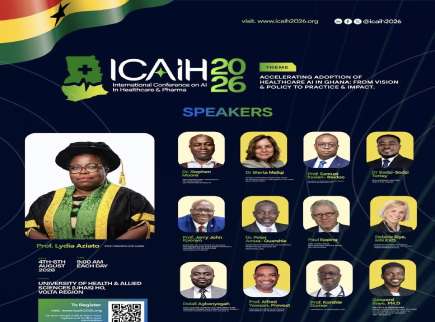
The University of Health and Allied Sciences (UHAS) will host Ghana’s first International Conference on Artificial Intelligence in Healthcare (ICAIH 2026) from August 4 to 5, 2026 in Ho, to advance the country’s digital transformation agenda in healthcare and pharmaceutical services.
The conference on the theme: “Implementing AI in Healthcare in Ghana: From Vision and Policy to Practice and Impact,” is being organised in collaboration with the Ministry of Health, the Ministry of Communication, Digital Technology and Innovation, the University of Missouri in the United States of America and international partners from the Netherlands.
A statement issued by the University in Accra said the conference would provide a national platform for policymakers, healthcare professionals, researchers, academics, technology innovators, entrepreneurs, development partners and students to explore practical approaches to integrating Artificial Intelligence into Ghana’s healthcare and pharmaceutical systems.
It said the initiative came at a time when AI was rapidly transforming healthcare globally by improving clinical care, disease surveillance, research, pharmaceutical development and health system management.
The statement noted that participants would examine how AI could enhance healthcare delivery while ensuring responsible, ethical and equitable adoption of emerging technologies across the sector.
The two-day conference will feature keynote addresses, panel discussions, technical sessions, AI adoption showcases and practical workshops covering hospital implementation of AI, data infrastructure and interoperability, ethics and governance, education, research and talent development.
Beyond the main conference, healthcare and pharmaceutical leaders will convene on August 6 for a high-level roundtable discussion on developing agentic AI systems to support sustainable health financing, clinical research, vaccine and pharmaceutical development and health leadership in Ghana and the wider sub-region.
Professor (Med) Alexander Ansah Manu, Director of the UHAS Institute of Health Research and Convener of the conference, described the event as a significant step towards developing a coordinated national framework for leveraging AI to improve healthcare delivery in Ghana.
He highlighted major challenges confronting Ghana’s health system, noting that the country served more than 33 million people with approximately one doctor for every 10,000 patients, compared with the World Health Organisation’s recommended ratio of one doctor to 1,000 people.
Prof. Manu said more than 900 women died annually from pregnancy and childbirth-related complications, while about 18,000 newborn babies also died each year, with many rural communities still lacking adequate access to primary healthcare services.
He further observed that the National Health Insurance Scheme continued to face sustainability challenges, while the growing burden of non-communicable diseases was placing additional pressure on the country’s already stretched healthcare system.
“These are not just numbers but Ghanaian lives at risk, doctors and nurses stretched beyond limits, and a health system that must urgently do more with less,” Prof. Manu said.
He urged stakeholders to embrace Artificial Intelligence as a tool for solving healthcare challenges rather than fearing it, stressing that Ghana must develop sustainable systems to maximise AI’s potential in strengthening healthcare delivery and accelerating innovation.
“For now, we must see AI as an ‘alien’ with humanoid characteristics. We must not fear it but prepare, welcome, embrace and learn to live with it to maximise its utility for our healthcare system,” he said.
The statement said the conference would enable stakeholders to share experiences, identify implementation gaps and develop a roadmap to guide the responsible adoption of AI in healthcare in Ghana and across Africa.
It will also strengthen partnerships among government agencies, academia, regulators, healthcare providers, technology companies and development partners.
Prof. Manu encouraged healthcare professionals, researchers, students, policymakers, regulators and technology innovators to participate actively in the conference.
“We welcome you all to be around the table when these pivotal transformations are shaped for advancing our health. If we must own our health, it starts from now. We cannot afford to be passive onlookers and consumers of products, but shapers of our own health destiny and health system destination,” he added.