
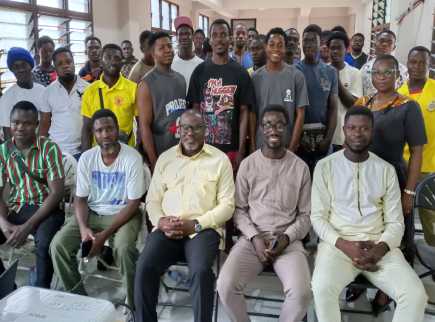
The Eastern Regional Coordinating Council, with support from the United Nations Population Fund (UNFPA), has engaged Okada riders on adolescent sexual and reproductive health to help reduce teenage pregnancy and violence against adolescent girls in the region.
The training equipped the participants with knowledge on adolescent health, causes and consequences of teenage pregnancy, sexually transmitted infections (STIs), and violence against women and girls.
Speaking with participants at Asokore in the New Juaben North Municipality, Mr Michael Agyeman, the Eastern Regional Programme Focal Person of the GOG-UNFPA Eighth Country Programme, said the programme was aimed at empowering young people to make informed decisions and avoid behaviours that could jeopardise their future.
He said the participants would also serve as points of contact and peer educators by sharing the knowledge acquired with their colleagues, fellow apprentices and other young people in their communities.
He expressed the Region’s appreciation to UNFPA for its continued support towards addressing adolescent health and other challenges confronting young people.
Mr Isaac Koramoah Asante, the Eastern Regional Director of the Department of Social Welfare, said the engagement helped the youth to understand, in simple terms, what constituted violence against women and girls including sanctions applicable to persons who engaged in such acts.
Among the violent behaviours are physical assault, incest, rape adoption and economic abuse.
He advised the youth to avoid behaviours that could result in their prosecution and urged them to respect the rights, safety and consent of others.
According to him, the interaction had enabled some young men to recognise that certain behaviours they had previously considered acceptable were wrong and needed to be changed.
Mr Asante expressed the hope that continued education and awareness creation would contribute to positive behavioural change among the youth.
Mr Moses Tetteh, the Head of the Department of Gender, said addressing issues surrounding teenage pregnancy and encouraging young men to take responsibility helped to curb the situation.
He said gender inequality was one of the factors contributing to the increasing rate of teenage pregnancy in the region, stressing the need to engage young men, particularly those who impregnated teenage girls.
He stressed that teenage pregnancy was not only a problem for girls but required the involvement of boys and men in finding lasting solutions.
He urged the young men to make responsible choices, respect girls and women, and contribute to creating an environment where adolescents could make informed decisions about their sexual and reproductive health.