
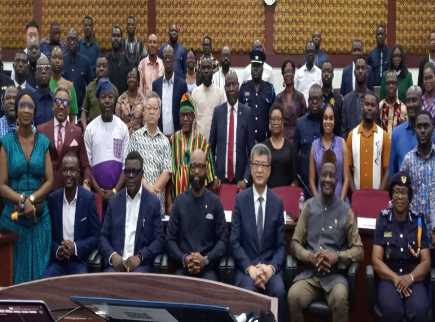
The Africa-China Centre for Policy & Advisory (ACCPA), and the China Europe International Business School (CEIBS Africa) have organised a High-Level Ghana-China Zero Tariff Policy Roundtable in Accra.
The roundtable was a strategic policy dialogue that convened senior leaders from government, the private sector, financial institutions, development partners, academia, and the Chinese business community to explore practical approaches to leveraging China’s zero tariff policy to strengthen Ghana’s export competitiveness and deepen Ghana-China economic cooperation.
Mr Paul Frimpong, the Executive Director of ACCPA, said the roundtable facilitated informed discussions on export readiness, market access, trade facilitation, investment opportunities, and policy priorities to enable Ghanaian businesses to maximize the opportunities presented by China’s expanded market access initiative.
He said the Government of Ghana, through its various Ministries, Departments and gencies, had been working to deepen its understanding of the potential benefits of the policy.
Mr Frimpong said ACCPA, as a think tank focused on Africa-China relations, had a role to play in supporting government by bringing together key stakeholders from the public and private sectors, as well as members of the Chinese community, to generate ideas and recommendations ahead of Ghana’s decision to sign onto the policy.
He said the discussions had generated practical recommendations that could help Ghana position itself to fully benefit from the policy.
Mr Frimpong said ACCPA and its partners would consolidate the ideas and recommendations into a workable policy document and submit it to relevant government agencies for consideration.
Addressing participants, Ambassador Cong Song, Chinese Ambassador to Ghana, said China’s zero-tariff policy had created new opportunities for Ghanaian products to access the Chinese market.
He said Ghana’s exports to China reached $2.67 billion in 2025, representing a 33.9 per cent year-on-year increase.
The Ambassador identified Access, Alignment and Advocacy as key pillars of the initiative, saying the policy would reduce the cost of Ghanaian products entering China and improve their competitiveness.
He identified processed cocoa, cashew, shea butter, pineapples, mangoes and coconuts among Ghanaian products with strong export potential.
He urged stakeholders to address institutional bottlenecks, particularly cross-sectoral coordination, Rules of Origin certification and customs clearance, which could undermine the benefits of tariff-free access.
He also stressed the need for Ghanaian producers to meet Chinese quality, inspection, quarantine, cold-chain and processing requirements.
The Ambassador said the policy could attract Chinese investment, technology, equipment and managerial expertise into Ghana, while promoting local processing and value addition.
Prof Gordon Adomdza, the Director of CEIBS Africa, said China had removed tariffs on 100 per cent of tariff lines for 53 African countries, creating a major market-access opportunity for the continent.
He, however, said zero tariffs alone were not enough, stressing the need for Ghanaian businesses to overcome challenges relating to certification, packaging, quality, consistent supply, cold-chain systems, finance and access to buyers.
He urged Ghana to move beyond the export of raw materials and focus on processing, packaging, branding, agro-processing and light manufacturing.
Prof Adomdza said the policy could also attract Chinese investment into Ghana, enabling companies to manufacture locally, create jobs and export value-added products to the Chinese market.
He noted that the current preferential arrangement would run until April 2028, making it necessary for Ghanaian businesses to become certified, organized and connected to Chinese buyers.
He said the private sector must take a leading role by securing finance, meeting quality standards, negotiating contracts and establishing strong relationships with Chinese buyers.
Mr Dode Seidu, Chief Executive Officer of Trade Africa Academy, said the policy represented a potential game changer for Africa by providing an opportunity to diversify its traditional trade relations, which had largely been with Europe and the United States.
He said Africa must, however, address its limited readiness and the technical barriers that could prevent businesses from benefiting fully from the policy.
He called for technical assistance from China in areas including Sanitary and Phytosanitary (SPS) measures, Technical Barriers to Trade (TBT), trade negotiations and compliance with Chinese market requirements.
Mr Seidu also urged African countries to use the opportunity to attract more Chinese Foreign Direct Investment, technology and expertise to establish production facilities on the continent.
He said this would promote technology transfer, strengthen productive capacity, create jobs and enable African countries to produce and export more value-added goods.
He further called for stronger supply chains and greater continental coordination to ensure that countries at different levels of industrialisation could benefit from the policy.