
Circular economy models are being recommended to minimise environmental impact and promote resource efficiency throughout the textile and apparel value chain in Ghana.
It is envisaged that, the adoption of these principles will provide a framework for producers and consumers to rethink material flows, production processes, and consumption habits toward achieving sustainability in the industry, thereby positively impacting Ghana’s developmental agenda.
These are based on the three pillars of sustainability – Economic, Social and Environment, grounded by the Triple Bottom Line (TBL) model to optimize productivity within segments of the textiles and apparel value-chain.
They are the Sustainable Cotton Production Model (SCPM) for the cotton industry, Sustainable Performance Model (SPM) for textile firms, and Compliance Operational Model (COM) for the fashion industry.
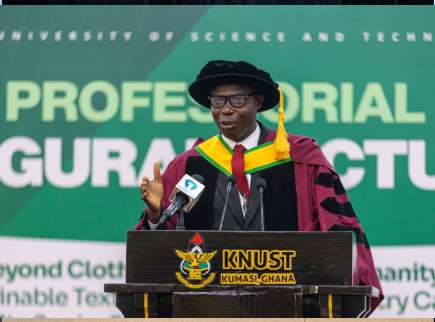
Ebenezer Kofi Howard, Professor of Textile Design and Technology at the Kwame Nkrumah University of Science and Technology (KNUST), who recommended these solutions indicated that, as Ghana strove to contribute its quota towards achieving the Sustainable Development Goals by 2030, the adoption of research developed sustainability models were crucial for the textiles and apparel sector and drive industrialisation agenda.
Delivering his professorial inaugural lecture at the KNUST in Kumasi, Prof Howard said studies had shown that circular economy models are gaining ground in the fashion and textile industry due to the rate at which waste is generated through the linear system of production.
Central to this are the principles of zero waste: reduce, reuse, and recycle.
He indicated that textiles and apparel products were arguably the number one indispensable commodities in the 21st century.
It is for this reason that the industry served as the pillar around which industrialization giant economies such as China, the US, UK, and Netherlands, evolved, due to its immense socio-economic benefits.
The lecture titled “Beyond Clothing the Nudity of Humanity: How Sustainable Textiles and Apparel Industry Can Rescue Ghana from its Socio-Economic and Environmental Quagmire” examined the state of Ghana’ industry, challenges and the way forward.
According to the don, the textiles and apparel sub-sector, which was once the leader in Ghana’s industrial sector, serving as an engine for economic growth and a massive employment generator for the country, has undergone a considerable decline over the years, largely due to internal and external bottlenecks.
The decline is not only attributed to the use of obsolete technology with a high cost of production, but also to Ghana’s involvement in trade liberalization programme leading to the influx of cheap textiles and second-hand clothing on the Ghanaian market that compete unfavorably with locally produced textiles and clothing.
This has resulted in a near-collapse of the textile industry in Ghana.
Prof Howard, therefore, called for the establishment of the Ministry of Textiles and Apparel to promote and champion Ghana’s industry for accelerated development, as the case is for India, which has transformed its textile industry with significant global impact.
The industry employs over 300 million people accounting for 8.6 percent of the world’s working population.
This implies that one out of every 12 of the 3.5 billion world’s working population is employed in the textiles and apparel supply chain, making it one of the world’s largest industrial employers (ILO, 2025; Textile Value-Chain, 2026).
It is estimated that for everyone billion US dollars in apparel exports, two million jobs are generated indirectly.