
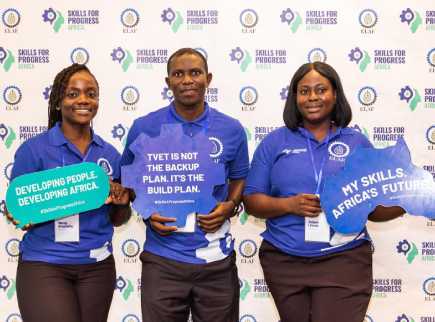
Skills for Progress Africa, a non-profit organisation, in partnership with ELAF Industrial Automation Limited, an engineering firm, has launched its inaugural fellowship programme with 10 Fellows to strengthen technical talent for Africa’s industrial development.
The programme, launched in Accra on the theme, “Building the Workforce That Will Build Africa,” seeks to bridge the gap between technical education and workplace readiness.
Mr Kwame Nyatuame, the Executive Director of Skills for Progress Africa (SFPA), said the inaugural cohort was the first step towards a broader ambition to grow the fellowship from 10 to 10,000 fellows, creating a scalable talent pipeline rather than a one-off training programme.
The fellowship was designed to develop professionals with technical competence, adaptable and capable of contributing meaningfully to Africa’s industrial transformation, he said.
Mr Nyatuame said the initiative was founded on the premise that technical education must translate into workplace competence and opportunity, adding that “education without experience is incomplete, and talent without opportunity is a tragedy.”
He said the SFPA would identify promising technical talent, develop them to industry standards, expose them to experienced professionals and connect them to companies and networks capable of supporting their career development.
Mr Solomon Bekoe, the Managing Director of ELAF Industrial Automation Limited, said the initiative was necessary because increasing enrolment in technical education had not automatically translated into productive employment for young people.
He said enrolment in pre-tertiary TVET programmes in Ghana had increased by almost 130 per cent over seven years, while youth unemployment among persons aged 15 to 24 in Greater Accra reached 49.3 per cent in the third quarter of 2025.
“We don’t have an unemployment problem. We have a connection problem,” Mr Bekoe said.
He said employability and productivity were two sides of the same challenge, noting that companies needed young professionals capable of diagnosing and resolving technical problems, while graduates needed opportunities to demonstrate those competencies.
He said as the founding technical partner, ELAF would provide structured technical training combining digital learning, Artificial Intelligence-supported simulation and hands-on practical experience through the Festo LX platform.
Mr Bekoe urged companies hosting Fellows to make workplace attachments genuinely experiential by giving participants real problems to solve rather than limiting them to observation, while using industry feedback to strengthen the fellowship model.
Mr Lloyd Ashley, Managing Director of Niche Cocoa, urged the Fellows to develop resilience, share knowledge and focus on improving productivity through process simplification, reduced downtime, data and automation.
He encouraged the Fellows to build on the foundations established by previous generations while striving to improve upon them.
The Fellows would combine technical training, mentorship, workplace exposure and personal, professional and leadership development, with organisers expected to use evidence from the first cohort to refine the model and guide its expansion to 100 fellows, then 1,000 and beyond, Mr Ashley said.
The long-term objective was to build a deeper pool of technically capable Africans equipped to solve workplace problems, improve productivity and contribute to the continent’s industrial development, he added.