
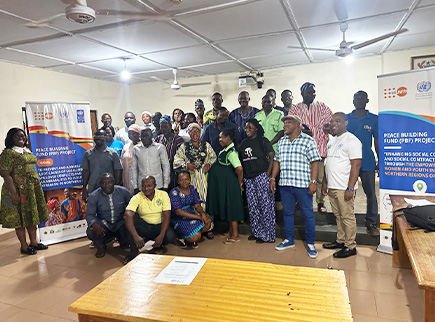
The United Nations Population Fund (UNFPA), in partnership with the United Nations Development Programme (UNDP), has engaged public service providers in the Wa West District towards promoting social cohesion necessary for enhancing peace and stability.
The Upper West Regional Coordinating Council facilitated the workshop, which sought to empower local governance institutions to enhance service delivery and establish referral pathways.
The initiative, under the UNFPA/UNDP peace-building project dubbed: “Enhancing social cohesion and social contract through empowerment of women and youth in three northern regions of Ghana”, was also held in the Sissala West District.
The UNFPA/UNDP had recognised effective service delivery and referral pathways as a tool for promoting peace and resolving conflicts, as poor public service delivery could generate tensions in the communities.
In a presentation on a public service mapping conducted under the project, Dr. Kwasi Owusu Poku, the Project Consultant, said the UNFPA was committed to building the capacity of public service providers to improve service delivery, foster trust, networking, inclusion, and social cohesion in the communities.
He explained that the “service mapping” was to identify available health, social justice, and social services that promoted social cohesion and social contract, especially for women and youth.

It also helped to ascertain challenges the service providers faced in their service delivery, the gaps in quality service delivery, and best practices that promote inclusion and participation of women and youth in service delivery.
Those challenges included difficulty in accessing communities due to poor road network, lack of essential service delivery logistics and equipment, outmoded cultural practices, and political interference in service delivery, among others.
Dr. Poku said the mapping revealed a strong partnership among public institutions and public-private partnerships, especially with Civil Society Organisations (CSOs) in service delivery.
He, however, indicated it also revealed low community awareness of available services and their human rights, and low involvement of women in decision-making, but improved youth participation.
Dr. Poku recommended continuous community engagement and sensitisation, engagement and monitoring of public institutions, actors, and structures to ensure more inclusiveness, responsiveness, commitment, and accountability in their service delivery.
Mr. Ishmael Selassie, the Programme Analyst at the UNFPA, appealed to the service providers to ensure gender equality in their service delivery in order not to fuel tension.
He stressed the need for collective efforts to address issues of gender inequality as that could hamper development, especially the progress of the youth and women.
Pognaa Rosemary Bangzie Mumwilma, the Queen Mother of Duong in the Nadowli-Kaleo District, Co-consultant on the project, emphasised the need to empower women and youth to know their Sexual and Reproductive Health Rights (SRHR) and to protect those rights.
She explained that protecting and promoting the SRHR of women and youth, and ensuring gender equality, was necessary for Ghana to achieve the Sustainable Development Goals (SDGs).
Pognaa Mumwilma also stressed the need for increased quality essential healthcare and population-based service for all, particularly women and youth in underserved communities.
Some participants, including health sector workers and security personnel, thanked the UNFPA and its partners for the initiative, as it had helped enlighten and empower them to ensure quality service delivery in their communities.